Talus: The Foundational Layer of the Agentic Onchain Economy
AI agents are expected to generate $3-5 trillion in economic value by 2030 according to McKinsey, with IDC projecting agentic systems will drive over 26% of global IT spending by 2029. Meanwhile, NVIDIA's Jensen…
 A1 Team13 min read
Introduction
AI agents are expected to generate $3-5 trillion in economic value by 2030 according to McKinsey, with IDC projecting agentic systems will drive over 26% of global IT spending by 2029. Meanwhile, NVIDIA's Jensen Huang calls them "the new digital workforce". The numbers suggest a massive shift is coming.
But here's the problem: despite billions flowing into AI agent development, current autonomous systems struggle to operate effectively in Web2 environments due to API restrictions, permissioned gateways, and centralized control points. While Web3's permissionless infrastructure is ideally suited for autonomous agents, today's implementations face a critical dilemma, either accept prohibitively expensive onchain computation or rely on centralized offchain execution that undermines the very sovereignty and composability that makes blockchains the natural habitat of autonomous systems in the first place.
This is the fundamental reason why autonomous agents remain isolated experiments rather than the economic primitives everyone's predicting. Without proper infrastructure, you can't have agents that are simultaneously verifiable, autonomous, and economically integrated. The "brain" (AI reasoning) is too expensive to run onchain, while the "hand" (execution) lacks the trust and composability requirements for real adoption.
@Talus_Labs is building the economic infrastructure layer specifically designed to solve this. Not by forcing AI computation onchain or punting everything to centralized servers, but through a hybrid architecture that separates coordination from computation, keeping the trust properties of blockchain while maintaining the performance characteristics needed for real-world agent operations.
The Rise of Onchain AI Agents
By unlocking new levels of automation, AI agents are set to disrupt how humans and machines interact with applications and the internet. Their ability to operate 24/7, manage complex tasks, and reduce human error is clear. However, bringing these capabilities onchain has faced significant technical hurdles, resulting in two suboptimal solutions:
- Onchain AI Model Computation: This approach, which runs AI models directly within smart contracts, is the most "trustless" solution, but is prohibitively expensive and computationally limited. It cannot support the state-of-the-art (SOTA) models required for true adaptive intelligence.
- Offchain Agents with Wallets: The dominant approach today uses centralized offchain agents holding private keys. This model fails Web3's core promise; it lacks composability, introduces single points of failure, and offers zero onchain verification. These are not true crypto-native agents.
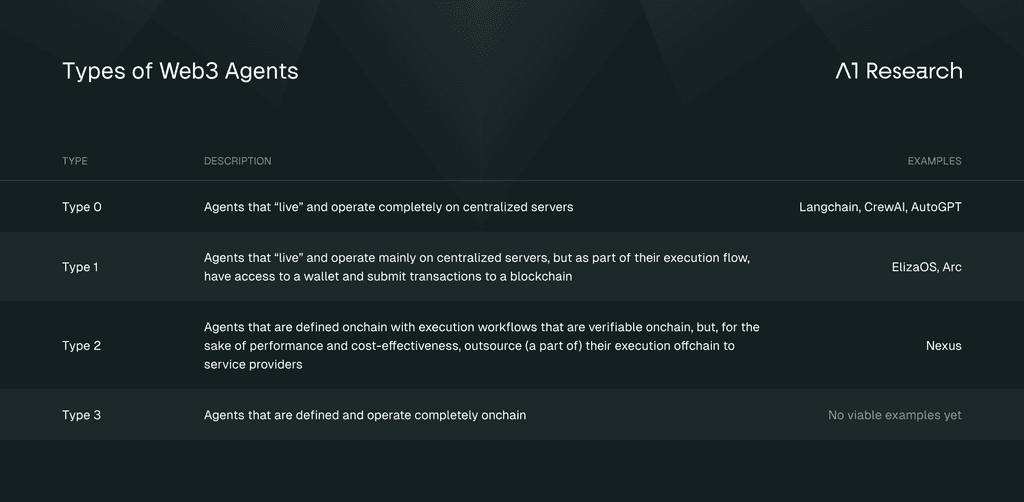
More specifically, these "Offchain Agents with Wallets" (or Type 1 agents) suffer from three critical limitations identified by Talus Labs:
- Lack of Composability: They do not have standard protocols for inputs and outputs, making it difficult for them to interoperate with other onchain services or reuse existing ecosystem tools. This bottleneck severely limits agents’ ability to take advantage of Web3’s inherent composability.
- Insufficient Asset Management: Relying on a simple private key is dangerous, especially as AI models can "hallucinate". This creates a need for fine-grained, onchain permission controls that a simple wallet cannot provide. However, by leveraging the programmability of smart contracts, Web3 agents can be customized to have all necessary features to ensure maximum security.
- Limited Service Quality Choices: Developers are forced into a rigid trade-off between expensive, secure onchain computation and high-risk, non-verifiable offchain computation.
These limitations, a "brain" that is too expensive to run onchain and a "hand" that isn't trusted or composable, have prevented a true agentic economy from emerging. That is precisely the problem Talus and its core protocol, Nexus, are designed to solve.
While discussions around the potential use cases and efficiency drivers surrounding AI agents draw substantial expectations, the gap between what is possible and what will be possible is still very wide.
Talus is narrowing that gap by creating the necessary base layer for AI agents to move from centralized, dependent actors to decentralized, independent members of a new AI-driven economy.
Each agent will be an independent and trackable "being," with its own income, expenses, and provable behavior.
Within this agentic economy, $US will serve as the dominant monetary standard, drawing demand from every agent-based interaction within the ecosystem.
Meet Talus: Laying the Infrastructural Basis for the Agentic Revolution
The rise of AI agents in everyday life is set to explode over the next several years, and before long they'll outnumber humans in general.
While this may sound extreme, it's actually a natural continuation of the progression of machine-driven systems; machines already outnumber humans by 80:1.
By providing the foundation for machine-to-machine economy, AI agents are set to drastically shift how commerce takes place.
You can think of Talus as the settlement layer for this new machine-driven economy. And within this economy, the $US token represents the unit of account for non-human economic activity.
To accommodate the coming surge of agentic identities, Talus has introduced the Talus Agentic Framework (TAF). TAF is a set of standard interfaces that define how general computation can be exposed as callable onchain services. This framework is built on three core components:
-
Talus Tools: These are the atomic building blocks of the ecosystem. A Tool can be anything, a function in an onchain smart contract (like a DEX swap) , an offchain Web2 API (like an LLM inference engine) , or even another Talus Agent.
-
Talus Workflows: These define the execution logic, represented as an onchain “Directed Acyclic Graph (DAG)”. The workflow dictates which tools are called, in what order, and how data flows between them.
-
Talus Agents: This is the crucial third component, an onchain identity associated with one or more onchain assets and workflow services. Unlike a Type 1 agent, a Talus Agent is not controlled by a private key. Instead, its assets and capabilities are managed by transparent smart contract logic. This allows it to hold assets securely and execute workflows with auditable, fine-grained permissions.
This framework allows any dApp to securely access computational resources far beyond the limits of a traditional smart contract.
Nexus: The Engine of the Agentic Economy
If TAF is the blueprint, Nexus is the engine that implements it. Nexus is a decentralized agentic automation protocol built on the Sui network that enables secure, verifiable, and composable AI-driven workflows.
The choice to build Nexus on the Sui network was deliberate. The Talus whitepaper identifies three specific advantages of the Sui Move stack for this architecture:
- Onchain Logic Security: The Sui Move VM's design inherently enhances security and simplifies the development of secure protocols for managing valuable resources.
- Flexible Object Model: Sui’s object model is highly effective for abstracting and managing onchain assets and agent capabilities, enabling precise and adaptable resource management.
- High Performance: Sui's architecture supports efficient concurrency, allowing Talus to process multiple agent workflows simultaneously without compromising security.
Crucially, Nexus does not attempt to run expensive AI models onchain. Instead, it employs a highly efficient hybrid architecture that separates coordination from computation:
- Onchain Coordination: The Talus Workflow (the DAG), agent permissions, and asset management are all defined and stored onchain via smart contracts. This provides the system with a transparent, immutable, and censorship-resistant "nervous system".
- Offchain Execution: Compute-heavy tasks (like LLM reasoning or complex calculations) are performed by offchain Talus Tools.
- Decentralized Coordination: A trust-minimized Leader Network, a decentralized set of nodes, acts as the messenger, orchestrating the workflow. It listens for onchain events, triggers the necessary offchain Tools, and delivers their results back onchain to the next step in the DAG.
This "Type 2" agentic framework (as defined by the Talus team) provides the best of both worlds: the performance and low cost of offchain computation combined with the trust, verifiability, and composability of onchain coordination.
Overcoming Key Bottlenecks
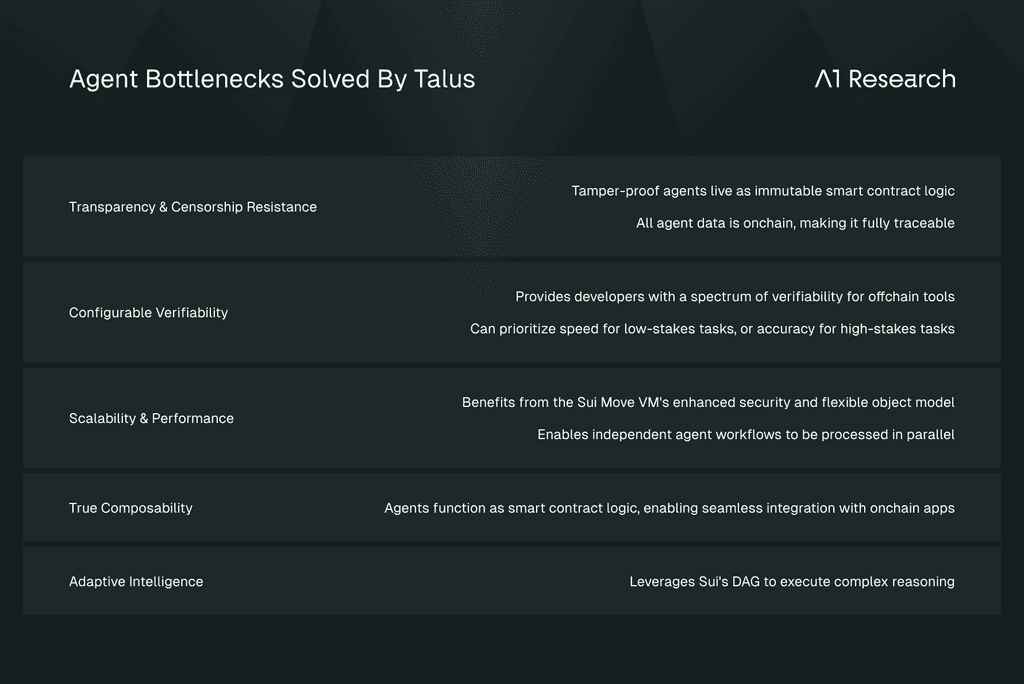
By powering AI agents with this unique hybrid architecture, Nexus unlocks the true potential of an onchain agentic economy.
Transparency & Censorship Resistance: Unlike centralized "black box" platforms, all coordination logic, permissions, and agent interactions are defined by immutable onchain workflows. This means anyone can audit an agent's intended decision-making process at any time, providing maximum transparency and ensuring its core logic cannot be tampered with.
Configurable Verifiability: Nexus moves beyond the simplistic "all or nothing" trust model. It recognizes that not all tasks require the same level of security. It provides developers with a spectrum of verifiability for offchain tools:
- Independent Tools: For low-stakes tasks, a developer can use an offchain tool without safety guarantees, optimizing for speed and cost.
- Verifiable Results: For financial tasks, the agent can enforce strict onchain permissioning (e.g., only allowing swaps with pre-approved contracts), verifying the result without verifying the computation.
- Verifiable Computation: For high-stakes tasks, the workflow can require the offchain tool to submit a zero-knowledge proof (ZKP) or a TEE-based signature to cryptographically prove the computation was executed correctly before proceeding.
Scalability & Performance: Built on the Sui network, Talus benefits directly from its high-performance infrastructure. Talus leverages the Sui Move VM for its enhanced security and the flexible object model to securely abstract agent resources. This architecture supports efficient concurrency, enabling independent agent workflows to be processed in parallel, which is critical for scaling a global agentic economy.
True Composability: Within TAF, agents and tools share a unified onchain interface. This means a yield-maximizing agent can seamlessly compose tools from a dozen different DeFi protocols. More powerfully, an entire Talus Agent can be wrapped and offered as a single Talus Tool , allowing developers to build complex, multi-agent "swarms" that collaborate to solve problems.
Adaptive Intelligence: The DAG-based workflow allows agents to execute complex, multi-step reasoning. This structure allows an agent to leverage powerful SOTA LLMs as offchain "brain" tools, analyze the results, call other tools (like data oracles), and then make a final, context-aware decision onchain, all without the prohibitive gas costs of onchain computation.
Talus’ Agent-as-a-Service (AaaS) Economy
Talus's architecture is designed to fuel a vibrant, permissionless economy built on three reinforcing layers:
- Tool Marketplace (TM): This is the base layer where developers can publish and monetize atomic Talus Tools. This could be a wrapper for an LLM API, a price oracle, or a specific DeFi function. Every time an agent's workflow uses this tool, the tool's creator earns a fee.
- Agent Marketplace (AM): Here, developers can build and sell complete autonomous agents (e.g., an automated "buy-low-sell-high" investment agent). These agents are constructed by composing various tools from the TM. Users can then deploy or customize these agents for their own needs.
- Agent-as-a-Service (AaaS): This allows any existing Web3 dApp to integrate a Talus Agent as a smart, self-operating component. For example, a DEX could integrate an agent that automatically generates and publishes audit reports for newly listed tokens.
This ecosystem creates a compounding loop: more tools enable more powerful agents, which in turn drive new use cases and applications, increasing demand for all components.
Early Applications
To bootstrap this economy, Talus is launching several flagship applications:
- Talus Vision: The primary onboarding tool for developer adoption, providing a no-code visual workflow builder that makes the Nexus protocol accessible to everyone. It functions as an intuitive Agent Marketplace, allowing users to design, test, and deploy agents via a "drag-and-drop" UI.
- IDOL.fun: The ecosystem's first consumer-facing product, demonstrating agents as economically productive entities. It includes a launchpad for Twitter-based AI chatbots (IDOLs) that can be "hired" to perform tasks and earn revenue. IDOL.fun’s flagship app is AvA (Agent vs. Agent) Markets, an arena for autonomous agent-on-agent competition. Speculators can bet on the outcomes of provably fair agent-based games, trusting the transparent onchain rules. As the Talus ecosystem expands, IDOL.fun will serve as the gateway to onboard new users – driving activity, liquidity, and volume for the native $US token.
For any online ecosystem to consistently thrive, it needs sustainable activity from developers and users alike. Many existing ecosystems in Web3 lack products that are specifically built for onboarding both parties, but this is where Talus thrives. By providing a simple, no-code interface for building new products, and an entertaining set of interactive applications to attract new users, Talus Vision and IDOL.fun stand out as an impressive product duo to spur sustainable ecosystem growth.
The** $US **Token
At the center of the Talus economy is its native currency: the $US token. By serving as the medium of exchange for agent-driven activity, $US demand grows alongside the community's innovation, creating a positive flywheel.
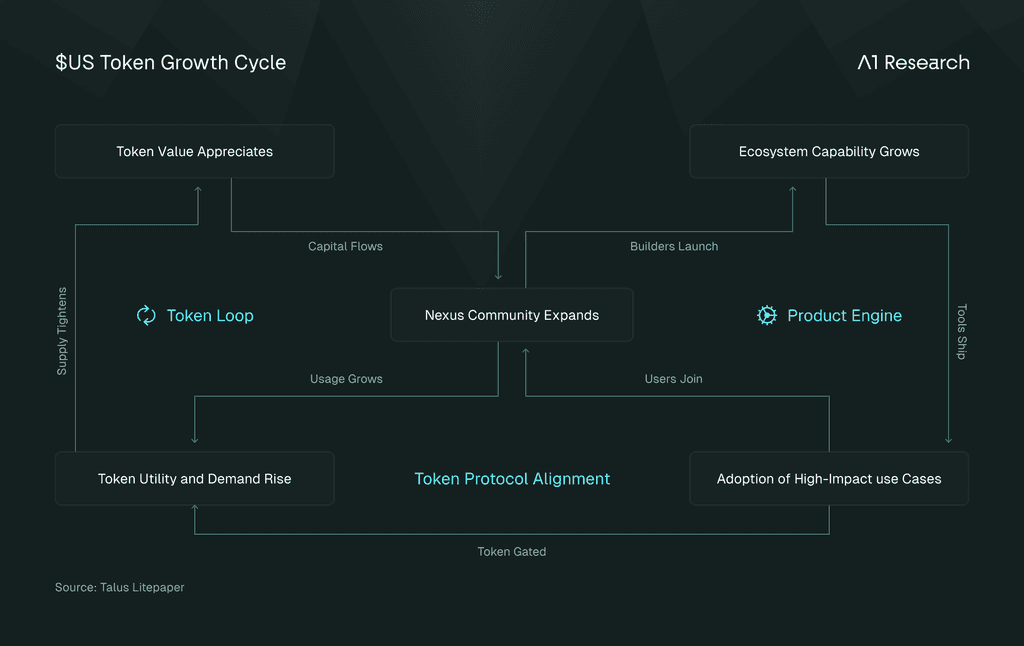
Beyond just utility, the $US token is central to the network's economic security. Talus implements a stake based tokenomic model where tool providers must stake assets onchain to be held economically accountable for honest execution. If a tool fails due to a liveness issue (e.g., it goes offline) or malicious behavior, its stake can be slashed and distributed as compensation to all the users whose workflows depended on it. This mechanism aligns incentives and creates a self-reinforcing growth cycle: as more applications use Nexus, demand for secure tools grows, which in turn increases the value staked and the overall security and reliability of the network.
The $US token has a total supply of 10 billion and serves three primary functions:
- Payment: Used to prioritize workflow execution and pay for trusted execution. Users can also pay with $SUI, which is automatically converted to $US via market purchases, creating constant demand.
- Participation: $US must be staked by nodes to join the Leader Network and by developers to register Talus Tools. This stake can be slashed for malicious behavior, creating direct economic incentives for honest operation.
- Privilege: Long-term holders gain access to community governance and exclusive benefits.
Why Talus Wins
As we mentioned earlier, the explosion of usage around AI agents is expected to be a multi-trillion-dollar opportunity, and Talus is positioned directly at the center of expansion.
By serving as the onchain hub for truly autonomous and verifiable agents, the activity within this ecosystem has massive potential. This directly benefits the $US token, which captures the economic flow of all agent transactions, verifications, and executions.
In summary, there are ,three structural advantages which ensure Talus becomes the dominant agent infrastructure:
- Hybrid architecture: Onchain coordination with offchain compute solves the cost/trust tradeoff that limits both Type 1 (wallet-based) and Type 3 (fully onchain) agent frameworks.
- Sui foundation: Move VM security with object-centric programming model naturally suited for modular agent design.
- Economic alignment: Stake-based security with slashing mechanisms makes tool reliability an economic necessity, not an option.
Conclusion & Outlook
While the world rushes to unlock the benefits of AI, agents are rapidly gaining recognition as the future of automated services. Talus plays a unique and vital role in this new era by providing the missing foundational infrastructure.
By intelligently separating onchain coordination (via the Nexus protocol and TAF) from offchain computation (via Tools), Talus is creating a functional, decentralized, and open agent-based economy. It overcomes the critical bottlenecks holding back agent adoption, ensuring that the next generation of autonomous systems can be trusted, adaptive, economically integrated, and scaled for the entire digital economy. It is the foundation for an AI-powered "smarter economy" that is truly decentralized, transparent, and composable.
With its testnet live since September 19th, 2025, and mainnet launch rapidly approaching, Talus is poised to become the definitive layer for the autonomous digital future.
A1 Resesarch Disclosures
The content provided in this article is for educational and informational purposes only and should not be construed as financial, investment, or trading advice. Digital assets are highly volatile and involve substantial risk. Past performance is not indicative of future results. Always conduct your own research and consult with qualified financial advisors before making any investment decisions. A1 Research is not responsible for any losses incurred based on the information provided in this article. This campaign contains sponsored content. A1 Research and its affiliates may hold positions in the projects and protocols mentioned in this article.
To follow the project's development and prepare for its upcoming mainnet launch, follow @Talus_Labs on X and join the developer community.
Share this research
A1 Team · Artificial Intelligence
More from A1 Research
View All ArticlesRead: Agentic Payments: Everyone's Arguing About Payment Rails. The Real Money Is Somewhere Else Entirely.  Artificial Intelligence
Agentic Payments: Everyone's Arguing About Payment Rails. The Real Money Is Somewhere Else Entirely.
Agentic payments are solving a real gap: AI-driven, “unbankable” businesses (solo devs, micro-APIs) can finally transact via stablecoins, with USDC supply reaching ~$75B and L2 fees dropping to ~$0.001, making…

 A1 Team, Sakshi17 min read
Read: The Card Always Wins  General
The Card Always Wins
The $15 billion market that's quietly becoming crypto's most compelling consumer product.
A1 Team21 min readRead: Front-Running the IPO: The $10 Trillion Pre-IPO Market Comes On Chain  Macro & Markets
Front-Running the IPO: The $10 Trillion Pre-IPO Market Comes On Chain
OpenAI and Anthropic called the private share tokens "void." Yet they're still trading and the on-chain market priced Anthropic's $965B round before the term sheet was signed. The issuer veto is the filter.
A1 Team15 min read