Why Everything Is Becoming a Perp
Perpification is what happens when financial nihilism meets infrastructure that lets you lever anything, in a world that won't sit still.



Perpification is what happens when financial nihilism meets infrastructure that lets you lever anything, in a world that won't sit still.
Executive Summary
- The visible symptom: Crypto's market structure has inverted, and the same pattern is leaking into every regulated venue.
- The actual driver: A generation that feels economically locked out is choosing instruments that match a world too volatile to hold.
- The cultural answer: Crypto skipped options because perps are what TradFi would have built without fifty years of regulatory plumbing.
- The structural argument: Calling this gambling is a category error; the only thing that matters is whether the rake extracts or routes.
- What comes next: AI agents make every niche market tradeable, and the volatility that drove perpification compounds into something much larger.
1. Spot Is Dead
BTC perp volume runs 5x spot. Most people on CT have stared at this number so long they've stopped seeing it.
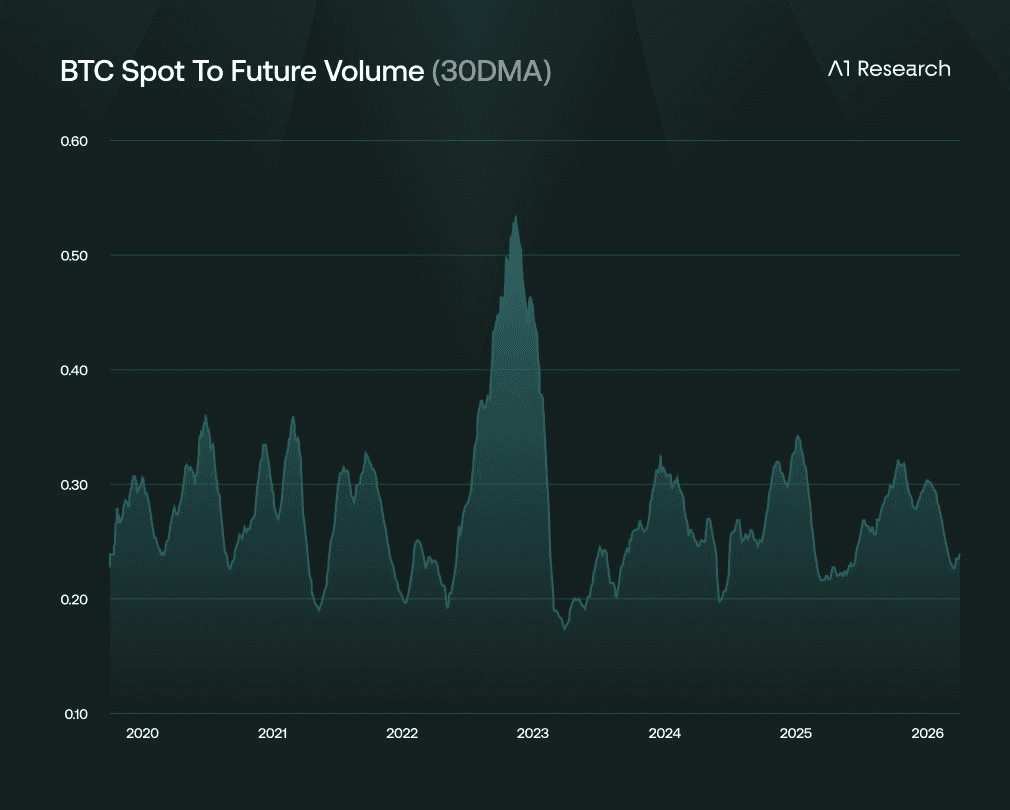
That's the problem.Five times. Think about what that ratio means. It's not derivatives layered on top of a healthy spot market. It's a market structure where holding the underlying is a niche behavior and trading the synthetic is the default. The spot market is now a feed. The thing we used to call "the market" is the reference price for the actual market.
This isn't a crypto phenomenon anymore. The evidence is piling up:
- Polymarket and Kalshi launched US perps the same day (April 21, 2026), with Polymarket's tagline shifting from "we price the future" to "now you can lever it"
- HIP-3 cracked the door on real-world asset perps and Hyperliquid silver hit $1B in daily volume in early 2026
- During Iran tensions, Hyperliquid did over $1B in oil over a single weekend, while every TradFi venue sat closed, watching crude move 30% from Friday to Monday open
Every good is becoming a perp.
That's the line worth sitting with. A perp, unlike a spot position, lets you make money whether the price goes up or down. In a spot world, volatility is a tax. You're long, price drops, you bleed. In a perp world, volatility is the entire product. Direction is one bit of information. Magnitude is the whole game. Being short oil during Iran is the same trade as being long. Being short Tesla during a tariff scare is the same trade as being long during the rip.
The world right now produces more volatility per quarter than at any point most of us have been alive for. AI repricing labor markets in real time. Geopolitical realignment generating weekly tail events. Currency debasement now showing up in portfolio construction documents, not just niche substacks. The Fed isn't even the only meaningful actor in your P&L anymore. The Pentagon, OpenAI, and TSMC's fab schedule all show up on the tape.
Volatility is the fuel.
Buy-and-hold was a strategy for a world that ended sometime around 2021-2022 and we're only now writing the obituary. To understand why perpification is spreading and accelerating, you have to start with the demand.
2. Financial Nihilism Is the Correct Read
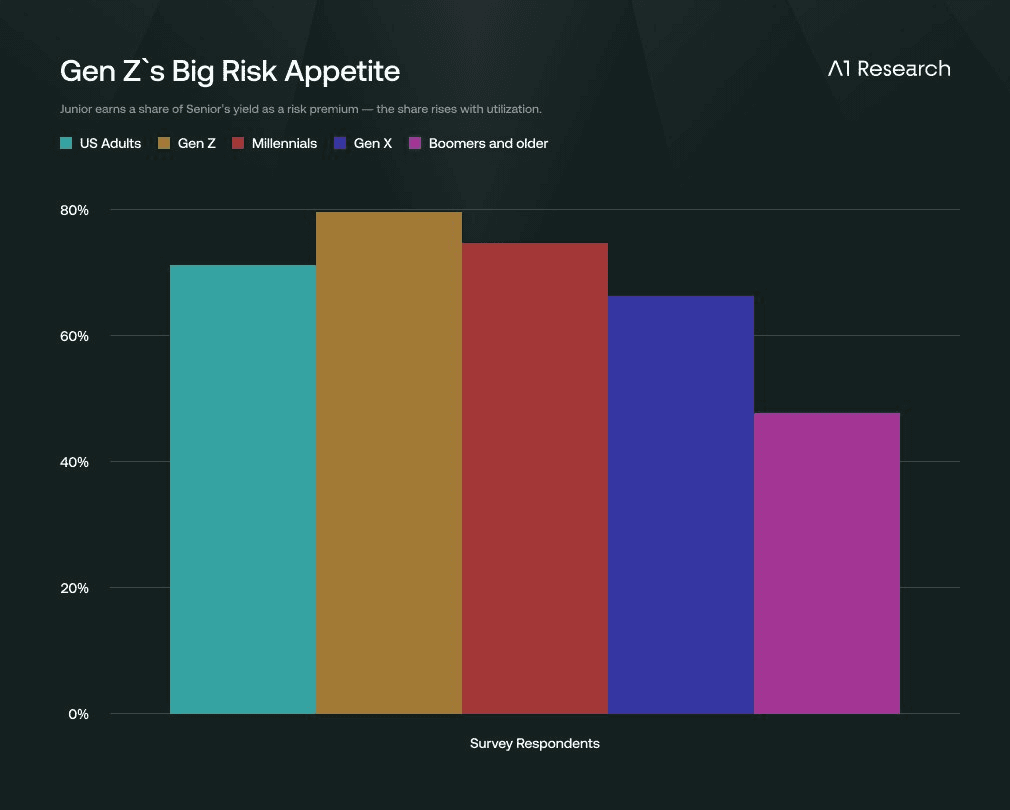
Northwestern Mutual ran the numbers in early 2026. 80% of Gen Z investors using high-risk assets explicitly said they're using them because they feel financially behind. 73% of all US adults using speculative instruments said the same thing. Bloomberg called it "financial nihilism." David Pakman at Consensus Hong Kong, more accurately, called it economic nihilism, and pointed out it isn't nihilism in the philosophical sense at all. It's a calculated response to structural barriers in wealth-building.
Run the math, any 28-year-old with a finance brain has already run it: six figures of student debt, a median home in any tier-1 metro requires capital they don't have and won't accumulate at the rate wages are growing. The institutionally-blessed wealth-building product is the S&P 500 at 8 to 10 percent annualized. At those returns, the gap between where they are and where they need to be doesn't close in their working life. It widens.
If the conventional path can't deliver, the rational play is to reach for instruments that can.
Even if the expected value is worse. Even if variance is brutal. The upside distribution is the only one that contains a path to the goal. This isn't a gambler's fallacy. It's correctly identifying you're not in a game you can win by playing more conservatively.
The version of this argument that gets repeated on CT is "the system is broken, so we apes." Right but lazy. The sharper version: the demand for leveraged, fast, asset-agnostic exposure isn't crypto-coded. It's global. We're just the segment that built the cleanest rails for it.
Different rails, same demand:
- Cboe data: retail accounted for over 60% of US options volume in 2025
- 0DTE phenomenon: structurally a leverage product for retail thinking in hours, not quarters
- Global FX/CFD volume: hit $30 trillion monthly in 2025, up 3x in a decade (60% Asia-Pacific)
- US retail futures volume: sits 50% above pre-pandemic levels
Same answer to the same question, which is: given the volatility regime we're actually in, what's the right retail strategy?
The answer the entire global retail cohort has converged on, independently, across jurisdictions, is to trade the volatility instead of trying to hide from it. Buy-and-hold is a strategy for a stable world. We don't live in one.
Which raises a question CT under-discusses. If the demand is the same, why did TradFi build options and we built perps?
3. The Cultural Gap That Made Perps Inevitable
Crypto skipped options. Not because Deribit doesn't exist. It's existed for years, the product is solid, the order books are deep enough. Most of CT can't tell you what gamma is and doesn't care.
The honest answer is that perps are a cleaner instrument for the actual demand, and options were never the right tool. They were the only tool TradFi had built.
Compare the cognitive overhead. To trade a 0DTE call on SPY, you have to pick a strike, manage theta over the day, reason about IV versus realized, and time the close before expiry. To trade a perp on anything, you pick direction and leverage. That's the entire decision tree. Set your liquidation level by setting your size. Done.
This points at a distinction nobody draws cleanly. Options sell volatility. Perps sell direction. TradFi conflated these because options were the only legal retail leverage product, so retail traders who wanted directional exposure were forced to express it through a vol instrument. The result is millions of TradFi retail traders explaining their positions in vol terms when what they actually wanted was direction. Just direction.
Crypto's cohort, given a clean choice, picked perps decisively. It wasn't close. The cultural verdict is in the data: 6x perp-to-spot ratio, 86 trillion dollars in annual perp volume, every major retail-facing crypto interface built around the perp orderbook.
This is also why perpification of everything is happening on these rails and not, say, 0DTE-ification of everything. Crypto's cohort revealed something about the underlying demand that TradFi's regulatory plumbing had been hiding for fifty years. People don't want vol exposure dressed as leverage. They want leverage. As clean an instrument as possible.
If perps are the cleaner instrument, the next question is whether the elegance is load-bearing or just window dressing for what is, structurally, the same thing as everything else.
4. Everything Was Always a Perp
You don't need a perps explainer. Skip ahead if you want. The only thing that matters here is the Paradigm reframe at the end.
Quick mechanics anyway, in case you want to send this to someone who needs them. A perp tracks spot. No expiry. Kept aligned via a funding rate longs and shorts pay each other when mark drifts from index. The funding rate is a feedback control system: the further the drift, the bigger the corrective payment. Same logic as a thermostat.
The design choice that matters: liquidity concentrates in one orderbook. Compare to options markets, where every additional strike and expiry splits available liquidity into a thinner pool. A BTC perp market has one book. A BTC options market has hundreds. Single-book structure means tighter spreads, more volume, deeper liquidity, and a flywheel that fragmented options markets structurally cannot match. This is the actual reason perp DEXs scale and options DEXs perpetually struggle, despite a decade of trying.
Now the actual point.
In 2024, Dan Robinson and the Paradigm team published a paper that recolors everything. Their claim, which I think is the most important conceptual move in DeFi this decade: stablecoins, margined futures, and AMMs are all power perpetuals at different exponents.
Crypto-collateralized stablecoins like DAI? Zero-power perpetuals. Margined futures like dYdX? 1-power perpetuals. Constant-product AMMs like Uniswap? Replicating portfolios for 0.5-power perpetuals. Squeeth? 2-power perpetual.
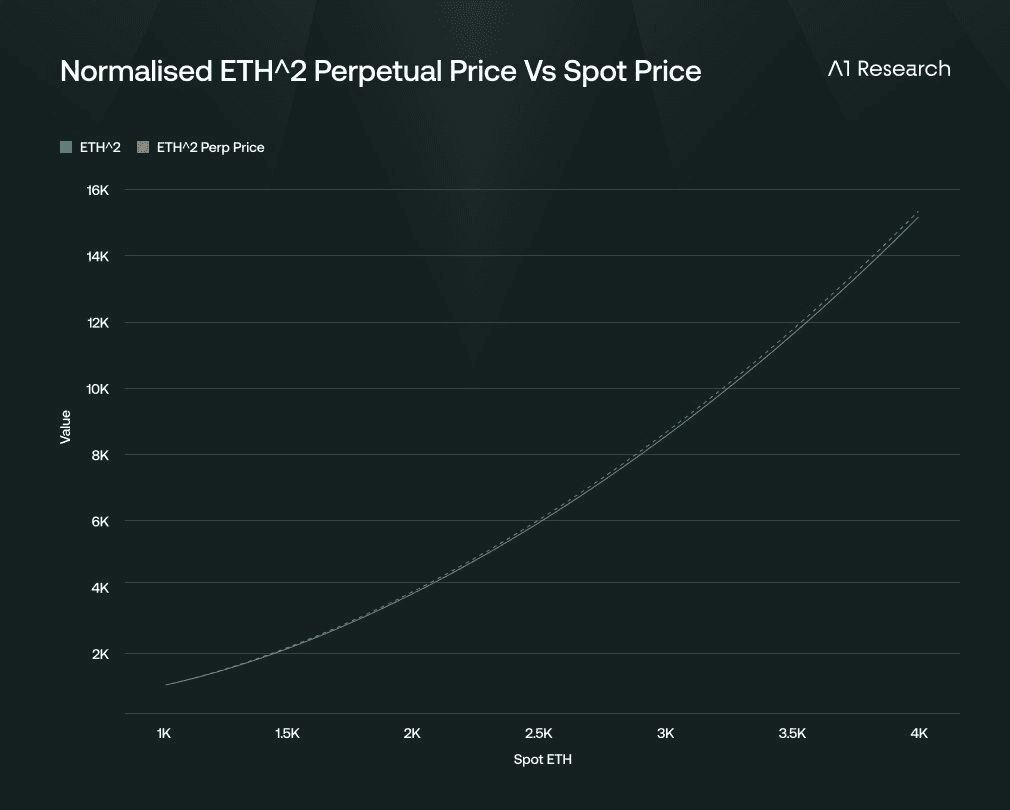
The entire DeFi stack: collateralized lending, derivatives, automated market making. All power perps at different exponents.
This isn't a metaphor. It's math. The collateral ratio, funding mechanism, and liquidation logic that defines a perp is the same machinery that defines DAI. A funding rate keeping a stablecoin pegged to a dollar is a 0-power perp's funding rate. The Uniswap LP position's payoff curve is the replication of a 0.5-power perp.
Perps aren't a crypto product that happened to spread. They're the underlying primitive that finance has been building variations of for decades, finally exposed in their general form because crypto stripped away the legacy plumbing that hid the structural identity.
Once you see it, you stop asking "why are perps eating spot." You start asking why it took this long for the underlying primitive to become the visible product.
The warning is the same warning that's always been there. At 10x, a 9.5% adverse move wipes you out. Cross-margin cascades during flash crashes. ADL forcibly trims winners when bankrupt liquidations exceed insurance fund and HLP buffers.
The 10/10 cascade in 2025 was a real event that real people lost real money in.
The mechanics that make perps elegant make them brutal at scale.
But here's the question of the elegance forces.If perps are the underlying primitive, then stablecoins, AMMs, and margined futures are all variations of the same machine.
Why does the financial press keep treating the crypto versions as gambling and the legacy versions as finance?
5. The Category Error
It's a category error. Once you see it, you can't unsee it. Once enough people see it, the regulatory frame collapses.
Here's the structural identity Lauris (@lzminsky) laid out cleanly. A casino bet: wager a dollar on red, receive two dollars if outcome occurs. A call option: pay a dollar premium, receive two dollars if strike condition is met. These are the same equation. Both are contingent claims. Both exchange present certainty for future contingency. Both have a market maker on the other side providing liquidity. The only thing that differs is the wrapper. Marble columns and a regulator-approved exchange license versus an Etherscan page and an audited smart contract.
Linguistic and cultural distinction, not structural.
Keynes said this. Schumpeter said this. Galbraith said this. The serious end of the economics profession has held this view for a century. The regulatory profession has built an enormous apparatus pretending otherwise, and the apparatus is now load-bearing for a system whose structural identity it can no longer credibly mask.
Then there's the historical scaffoldxbt2027 (@xbt2027) traced. Hyperfinancialization didn't start with crypto. It started in 1971, when Bretton Woods collapsed and the dollar detached from gold. Money became a pure symbol backed by trust. Two years later, in 1973, CBOE launched listed derivatives. From that moment, the financial system started building progressively more abstract claims on progressively more abstract underliers. MBS (Mortgage Backed Security) are derivatives of claims on real assets. CDS(Credit Default Swap) are derivatives on those derivatives. We've been trading signs about signs for over fifty years. Piketty's empirical work, return on capital running at 4 to 5 percent annually while real economic growth runs at 1 to 1.5 percent since the 1980s, quantifies the structural condition that makes financial nihilism rational.
Crypto didn't cause this. Crypto made it legible.
In every prior round of financialization, there was at least a fig leaf. A real asset somewhere at the bottom of the stack pretending to anchor the abstraction. With memecoins, the fig leaf comes off. The valuations are determined entirely by what xbt2027 calls the coordination game with iterated expectations: what other players believe other players will pay tomorrow. No Nash equilibrium. No anchor. Pure self-referential consensus.
The honest reaction to this isn't horror. It's recognition. The mechanism is the same one TradFi has been running for fifty years, just stripped of the comforting fiction that there was a real asset propping it up.
Now look at what's actually being built. Five and fifteen-minute crypto bets are doing 70 million dollars daily on Polymarket and Kalshi. Hyperliquid testnet has a recurring HYPE binary that settles every three minutes. Every major venue is converging on the same direction of travel: shorter, more repeatable, more monetizable cycles. Perps plus prediction markets plus memecoins are getting stitched into single interfaces, what FT called "gambling super apps." Same wallet, same screen. Sports outcome here, BTC binary there, microcap there.
Yes, it looks like gambling. Yes, it functionally is gambling. So is every options contract retail buys. So is the S&P. CFTC data suggests 80% of futures volume in major contracts is speculative, not commercial hedging. The line between investing and gambling is cultural, not mathematical, and it always has been.
Here's the structural difference that actually matters, which Lauris articulated and most CT hasn't fully internalized yet.
Traditional gambling is negative-sum because the rake extracts. Ten players bet 100 dollars each, casino takes 10%, 900 dollars redistributes among the players. Long-term, players lose. The system is designed to drain.
On-chain rails change this. Each wager can route into spot markets, deepening liquidity for the underlying. The rake doesn't drain. It routes. Every bet on a launchpad becomes a buy order that seeds liquidity. Every perp position generates funding flows and fees that recycle back into the protocol's economic loops. Speculation becomes the mechanism by which liquidity is injected, assets are distributed, attention is concentrated.
EV(network) = Σ EV(player) + EV(routing). When routing is positive, the network grows even as individual players lose. This is structurally different from Vegas. It's also structurally different from TradFi options markets, where the rake (spreads, broker fees, market-maker edge) extracts to off-chain entities that don't recycle the flow back into the underlying market.
This is the one thing TradFi commentators keep missing when they cover crypto-as-gambling. They're not wrong that it's gambling. They're wrong that gambling is necessarily negative-sum. The on-chain version has a different structural property than the Vegas version, and the structural property is the only thing worth arguing about.
The category error matters because it determines what gets built. Treat perpification as gambling and you regulate it like a vice. Push it offshore. Make it less transparent. Leave the human cost worse than under honest rails. Treat it as a financial primitive and you build transparent on-chain infrastructure with predictable rules and verifiable solvency. The argument isn't "speculation is good." It's "speculation is what's actually happening, at scale, on every rail, in every retail market, and the only question worth asking is whether we build for it honestly or pretend it's something else."
Polymarket changed its tagline from "we price the future" to "now you can lever it." That wasn't marketing. It was an admission. The rest of this is about what gets built once we stop pretending.
6. AI Eats the Loop
Everything above is the human version. Retail expresses demand, builders ship infrastructure, venues compete for flow. That version is already obsolete in the parts of the stack where it matters most.
Saneel’s (@sanlsrni) deconstructed speculation cleanly. Three components.
- The game : AI as market engineer: doesn't trade in markets, creates them (Kash spinning up prediction markets from trending content, perps on attention metrics, semantic markets like tmr.news)
- The players : AI as participant: turns PvP speculation into PvE structures (pay to face the bot, stake on bot vs. players, AI raid bosses)
- The process : AI as execution layer: compresses the arc from belief to trade (Robinhood Cortex, IBKR's iBot, natural-language trading interfaces)
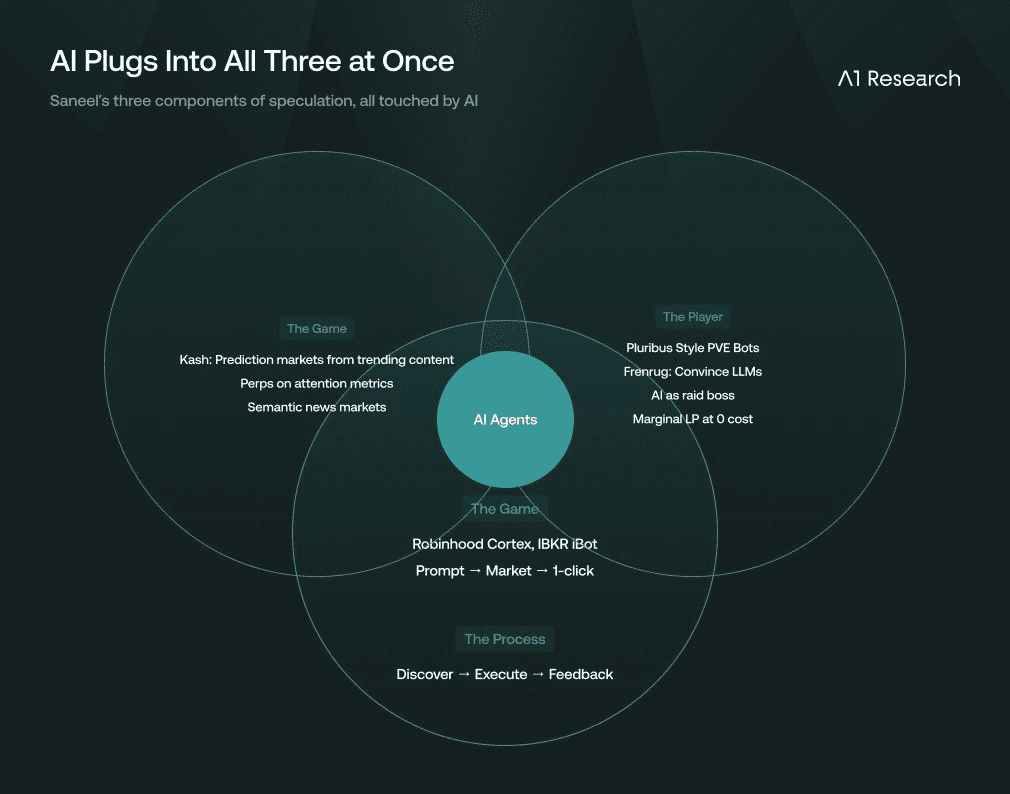
As a market engineer, AI doesn't trade in markets. It creates them. Kash spins up prediction markets in real time from trending content. Perps on attention metrics already exist. Semantic markets like tmr.news are running. Once a model can identify a tradeable question and write the contract for it faster than a human can notice the question is interesting, the universe of available markets expands by orders of magnitude. HIP-3 deployers are scratching the surface of this. Every novel data feed becomes a potential perp market, and humans aren't the bottleneck on identifying which feeds matter.
As a player, AI changes what the games can be. Pluribus beat poker pros by bluffing more randomly. The implication isn't just "AI is good at poker." The implication is structural. Historically PvP speculation games can be turned into PvE structures. Pay to face the bot. Stake on the bot versus other players. Leaderboard tournaments against an AI raid boss. Frenrug was the early version, letting users try to convince LLMs to move financial value. The next version is novel modes of speculation that only exist because there's a non-human counterparty whose presence reshapes the game itself.
As a process, AI compresses the entire arc from belief to execution. Robinhood Cortex, IBKR's iBot, the natural-language trading interfaces shipping every month. The endpoint is the product Saneel described. Input any prompt, any belief, any piece of media. Get matched to the most suitable markets and trades. Execute in one click. The product that owns that flow is worth more than the products that own any single piece of it.
The most consequential thing AI does to perp markets is solve the long-tail liquidity problem.
Right now, perp markets exist for roughly a thousand tokens out of sixty million plus that exist, plus a few hundred RWAs. The bottleneck isn't infrastructure. It's that human market-makers aren't economical for niche markets. Spreads are wide. Volume is thin. Price discovery is bad.
Nick (@nickemmons) has the cleanest version of this argument.
AI agents have a marginal cost of attention approaching zero. They can monitor 100,000 markets at once, ingest specialized data the moment it publishes, execute on 1% edges, never get bored or tilted or distracted. For an AI agent, market-making "will TSMC's H100 capex exceed 40 billion dollars in 2026" is trivial. Every niche market that was previously uneconomic to run becomes viable. The TAM of correct-but-not-yet-priced information is vastly larger than what human traders can process.
This is what hyperfinancialization looks like as it lands. Not metaphorically. Literally.
- Granular asset markets: instead of trading Apple, you trade Apple Services as distinct from Apple iPhone
- Worldview vaults: deposit into the agent representing your thesis (accelerationist, doomer, China-bull, debasement-pilled), let it execute across thousands of markets
- Futarchy: bet on outcomes instead of voting on preferences; implement the policy with the highest market price
And here's the part nobody on CT has fully worked out yet.
AI doesn't just process volatility. It creates it. Markets where AI agents are 90 percent of liquidity will move faster, react harder, and reprice more frequently than human-dominated markets ever could. The volatility regime that drove perpification in the first place will intensify as AI takes over participation.
Perpification isn't the endpoint of a high-volatility world. It's the entry point to a much higher-volatility one. Which forces the question. When AI agents are the marginal liquidity provider on every market, and any opinion is leverable in real-time, what does retail participation even mean?
Are humans speculators? Or are humans the slow, biased, emotional counterparties for AI agents that out-process them by orders of magnitude in every dimension that matters? Polymarket's tagline arc, projected forward. "We price the future." Then "now you can lever it." Then "we price the future, and the agents trading it have already factored in your move."
Perpification of everything was always going to mean perpification by everything. Including agents that aren't human at all. The trade is no longer an asset. The trade is whether you're the player or the LP.
7. Conclusion
Volatility is the fuel. Perps are the engine. AI is about to be the driver.
The world is producing more uncertainty per quarter than at any point most of us have been alive for, and a generation that figured out the conventional path doesn't close their gap has decided to trade it instead of hide from it. That's not gambling. That's not nihilism. It's the cleanest available read of the environment we're actually in.
Crypto skipped options because perps are what people would have built if TradFi's regulatory plumbing hadn't held the wrong instrument in place for fifty years. And every assumption underneath that shift, that humans set the prices, that retail competes with retail, that liquidity is the bottleneck, breaks the moment AI agents become the marginal participant in every market.
The market is open. The agents are awake. Pick your seat.
Share this research
A1 Team, Sakshi · General
More from A1 Research
View All ArticlesRead: The Card Always Wins  General
The Card Always Wins
The $15 billion market that's quietly becoming crypto's most compelling consumer product.
 A1 Team21 min read
Read: Analyst Take: The Internet Is Learning How to Pay Itself and Crypto Is the Reason  General
Analyst Take: The Internet Is Learning How to Pay Itself and Crypto Is the Reason
Coinbase is building the AWS of agent commerce. AWAL + x402 + Stripe integration creates a full-stack moat on Base. Solana competes on speed, but integration depth will matter more than settlement time.
 Sakshi, A1 Team6 min read
Read: Zero: The Multi-Core Revolution or Maximum Hype?  General
Zero: The Multi-Core Revolution or Maximum Hype?
Zero introduces a heterogeneous "multi-core" architecture that separates execution (datacenter Block Producers) from verification (consumer-grade Nano Validators via ZK proofs), claiming 2 million…
A1 Team20 min read