Analyst Take: The Internet Is Learning How to Pay Itself and Crypto Is the Reason
Coinbase is building the AWS of agent commerce. AWAL + x402 + Stripe integration creates a full-stack moat on Base. Solana competes on speed, but integration depth will matter more than settlement time.



Our key takes:
- Coinbase is building the AWS of agent commerce. AWAL + x402 + Stripe integration creates a full-stack moat on Base. Solana competes on speed, but integration depth will matter more than settlement time.
- Identity is the sleeper play. ERC-8004's onchain reputation system (32,000+ agents deployed within a week via Daydreams) could matter more than payments. Whoever controls the reputation layer controls the marketplace.
- The real competition is crypto vs. Big Tech, not chain vs. chain. Google's AP2 will win high-trust consumer use cases. Crypto will own the long tail independent data, niche APIs, microtransactions where permissionless rails have a durable structural advantage.
- Crypto has a four-layer Agentic Stack, Infrastructure, Enablers, Tooling, Agents that extends Nvidia's five-layer AI framework with the economic coordination layer the machine economy was missing. For the first time, all four layers are simultaneously operational.
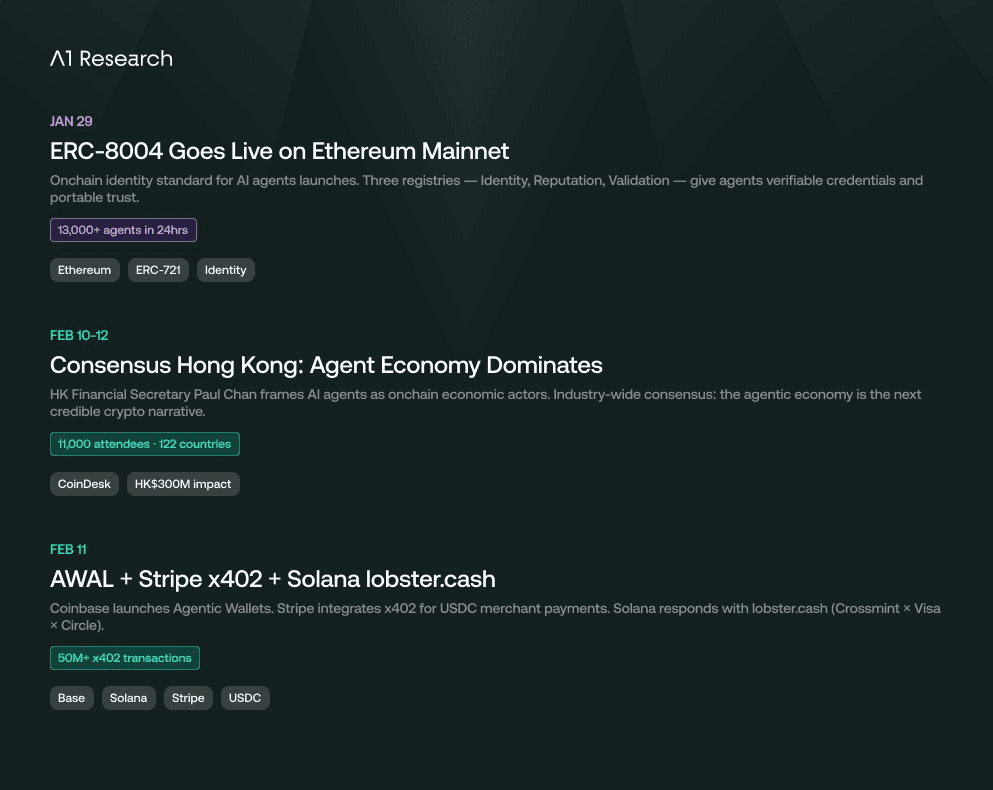
What makes this different from past crypto narrative rotations is that the demand is coming from outside of the crypto bubble. At Consensus Hong Kong 2026 with 11,000 attendees from 122 countries according to CoinDesk, Hong Kong's Financial Secretary Paul Chan described AI agents that "hold digital assets on-chain, pay service fees, and transact with each other". When a sovereign financial secretary frames your technology as national infrastructure, the conversation is really major. Multiple panels converged on the "Agentic Economy" as the only narrative with genuine cross-industry conviction even as attendees openly acknowledged that most existing crypto use cases are struggling.
Coinbase Is Playing to Win the Entire Agent Commerce Stack And Solana Knows It
Coinbase's AWAL isn't just a product launch, it's an ecosystem play disguised as a developer tool. By letting any AI agent get a wallet in under two minutes via CLI (Source: Coinbase Developer Platform blog, Feb 11), Coinbase is doing what AWS did to cloud computing: abstracting away complexity until the default choice is their infrastructure. The pre-built "Skills" trading, yield, payments via x402 mean agents don't just hold money, they actively participate in DeFi. This is a Trojan horse for Base chain adoption, and it's working.
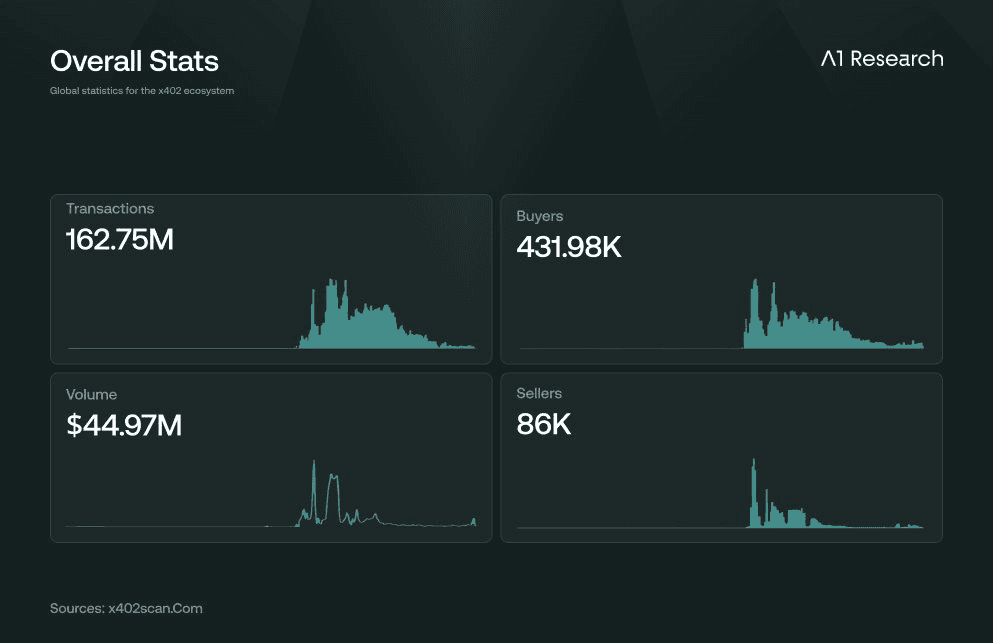
The x402 protocol (100M+ transactions since launch, Source: Coinbase) is where the real strategic bet becomes clear. By embedding stablecoin payments directly into HTTP requests agent hits endpoint, pays USDC, gets access, no human involved Coinbase is positioning crypto not as an alternative financial system but as a native internet payment primitive. This is a fundamentally different pitch than anything crypto has made before.
Source: x402.com
But Stripe's involvement is what transforms this from a crypto story into an infrastructure story. When a $140B payments company begins routing AI agent transactions through blockchain rails, it's not experimenting, it's hedging against obsolescence. Jeff Weinstein's framing was blunt: legacy payment systems are "tuned for humans" and cannot serve agent needs. CoinGecko's x402 adoption ($0.01/request, no API key needed) is the proof of concept: any data endpoint on the internet can now be monetised for machine consumption.
Solana's responded by posting lobster.cash built by Crossmint with Visa, Circle, Stytch (Source: Solana on X, Feb 12) within hours tells you everything about how seriously chains are taking this.
https://x.com/solana/status/2022015094641807651
Solana's pitch is strong on paper: 400ms finality, $0.00025/tx, 35M+ x402 transactions, $10M+ volume (Source: Solana x402 docs). But here's our take: Solana is playing catch-up on the ecosystem layer. Base has Stripe, Coinbase's merchant distribution, and gasless transactions for agents. Solana has faster settlement but in a world where Stripe handles the merchant relationship, raw speed matters less than integration depth. The chain that wins agent commerce won't be the fastest; it'll be the one with the most services agents can actually buy.
ERC-8004 Is the Sleeper Play And Identity May Matter More Than Payments
Payments are the easy part. Identity is the hard part. And identity is where the real moat gets built.
ERC-8004, co-authored by MetaMask, Ethereum Foundation, Google, and Coinbase introduces three onchain registries: - Identity (ERC-721 credentials), - Reputation (aggregated feedback, a credit score for bots) - Validation (independent work verification via staking, zkML, or TEE). Over 13,000 agents registered in 24 hours post-launch; Daydreams shipped 32,000+ compatible agents within a week via its Lucid SDK.
Why does this matter more than payments? Because without portable reputation, the agent economy devolves into a race to the bottom on price. Any agent can pay for a service that's a solved problem with x402. But which agent should you trust to manage your portfolio at 3am? Which agent has a track record of delivering accurate data? ERC-8004 turns trust into an onchain primitive, and that creates compounding network effects: agents with strong reputations attract more transactions, which build stronger reputations. This is the credit scoring system for a machine economy, and whoever controls the reputation layer controls the marketplace.
A16z crypto saw this coming. Their 2026 outlook introduced KYA - Know Your Agent arguing that "the industry that built KYC infrastructure over decades now has just months to figure out KYA". We think they're right, and we think Ethereum's first-mover advantage on ERC-8004 is being underpriced by the market.
The Real Competition Isn't Chain vs. Chain. It's Crypto vs. Big Tech
The chain wars (Base vs. Solana vs. Ethereum) will generate headlines, but the more consequential competition is architectural. Google's AP2 protocol operates within a closed ecosystem of vetted merchants intent, cart, and payment mandates flowing through Google Pay. It's consumer-friendly, but it's a walled garden. An agent operating within AP2 can only transact with Google-approved partners.
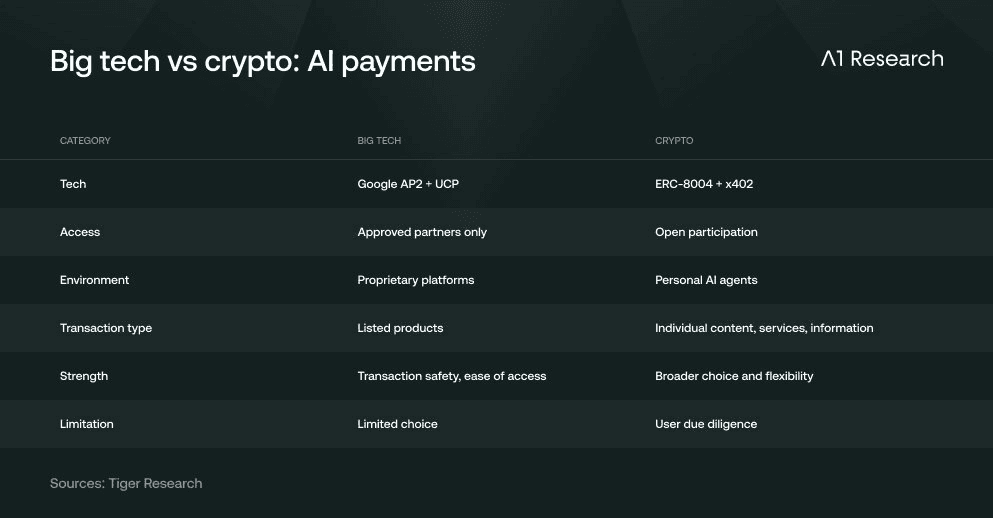
Our take: Big Tech will dominate the high-trust, high-value consumer use cases booking flights, purchasing goods, managing subscriptions. Crypto will own the long tail and the long tail is where the volume lives. Independent data providers, niche APIs, individual creators, micro-compute sellers, prediction market participants. These counterparties cannot be aggregated into a single platform. They need permissionless rails. An agent purchasing 1,000 images at $0.01 each or paying $1 for a research article needs payment infrastructure that is fast, final, and programmable not a checkout flow designed for humans buying sneakers. This is crypto's structural advantage, and it's durable.
Extending Nvidia's Five-Layer Cake: The Agentic Stack
Jensen Huang's Davos framework: energy, chips, cloud, models, applications captures the AI buildout from hardware up. But the crypto-AI convergence reveals a missing layer between models and applications: the economic coordination layer that governs how agents transact.
Crypto has a four-layer Agentic Stack:
- Infrastructure (Ethereum, Base, Solana settlement and programmability)
- Enablers (x402, ERC-8004, A2A, MCP converting blockchain into economic rails)
- Tooling (AWAL, lobster.cash, Lucid SDK lowering developer barriers)
- Agents (yield optimisers, arbitrage bots, commerce agents where value is generated)
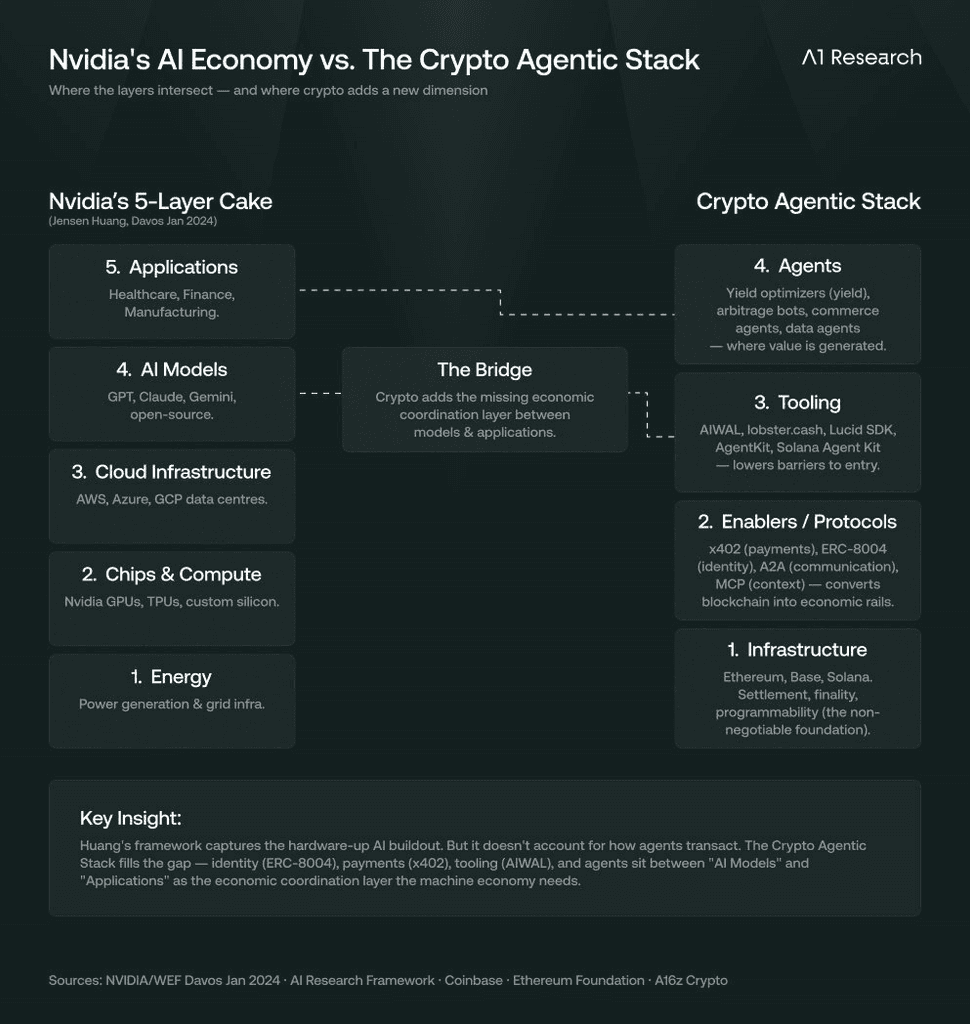
For the first time, all four layers are simultaneously operational. This is the thesis: crypto's next growth chapter isn't about convincing humans to use wallets. It's about making wallets invisible to agents that never had a choice. The chains and protocols that embed themselves deepest into this stack won't just capture transaction fees, they'll become the default economic infrastructure for a post-human internet. The question isn't whether this happens. It's who captures the margin.
Disclaimer: This analyst take is produced by A1 Research for informational purposes only. It does not constitute financial advice or an endorsement of any project, token, or protocol mentioned herein.
Share this research
Sakshi, A1 Team · General
More from A1 Research
View All ArticlesRead: The Card Always Wins  General
The Card Always Wins
The $15 billion market that's quietly becoming crypto's most compelling consumer product.
 A1 Team21 min read
Read: Why Everything Is Becoming a Perp  General
Why Everything Is Becoming a Perp
Perpification is what happens when financial nihilism meets infrastructure that lets you lever anything, in a world that won't sit still.
 A1 Team, Sakshi17 min read
Read: Zero: The Multi-Core Revolution or Maximum Hype?  General
Zero: The Multi-Core Revolution or Maximum Hype?
Zero introduces a heterogeneous "multi-core" architecture that separates execution (datacenter Block Producers) from verification (consumer-grade Nano Validators via ZK proofs), claiming 2 million…
A1 Team20 min read