The Card Always Wins
The $15 billion market that's quietly becoming crypto's most compelling consumer product.
 A1 Team21 min read
Introduction
There is an entire shadow economy built around the gap between what a Pokémon card looks like and what it actually is. Counterfeit cards have become sophisticated enough that casual buyers cannot reliably tell the difference by eye. Replicas with fake grading cases and swapped interiors have circulated on major platforms, resealed booster packs, where the best cards have been removed and replaced with commons, are common enough to have generated their own vocabulary among collectors. The term is "weighed packs", people carry pocket scales to card shops.
This is the logical outcome of an industry where the gap between a real card and a convincing fake can be thousands of dollars, where transactions happen between strangers, and where the infrastructure for verification is a third-party grading service whose cert numbers can be looked up but whose cases can be replicated. The traditional physical market has never solved this, solely managed it, through reputation systems and community knowledge, but the underlying vulnerability has never gone away.
Meanwhile, on-chain trading card marketplaces have gone from a niche experiment to one of crypto's highest-revenue consumer sectors. According to Artemis, the sector has generated over $200 million in cumulative revenue, with 2026 already exceeding 2025’s revenue while being in early June. Gacha's spending volume hit $250+ million in May 2026, up from $170 million in April, with June projected to reach another all-time high.
Tokenised physical collectibles do not fix counterfeiting at the source, but they move the point of trust from the individual transaction to the institutional layer. Once a card has been graded, vaulted, and minted on-chain, every subsequent sale is a transfer of a verified digital token, no photographs, no descriptions, no strangers. The card's history is public and its condition is locked. The chain of custody is unbroken from vault to buyer, and for the first time, the market's trust problem has an infrastructure solution.This piece is a high-level snapshot of that transition: what TCGs are, why they work as an asset class, where the on-chain layer fits in, and how it differs structurally from the NFT cycle of 2021.
1. The TCG ecosystem, a century of price discovery
Trading cards date to the 1800s, when tobacco companies inserted cards into cigarette packs as stiffeners and brand-loyalty tools. Scarcity turned many of those early cards into assets. The T206 Honus Wagner, part of the American Tobacco Company's 1909 - 1911 print run, has fewer than 50 authenticated copies in existence. One sold for $7.25 million in a private sale in 2022.
In 1993, Magic: The Gathering introduced gameplay mechanics to the format. The Black Lotus, an ultra-rare card from Magic's first print run with approximately 1,100 copies ever produced, sold for over $600,000 at auction, and reached $3 million in 2024. Then Pokémon pushed the category into mainstream global culture. The Pikachu Illustrator card, awarded as a competition prize in 1998 with only 39 copies ever made, sold for $5.275 million in 2021. In February 2026, Logan Paul sold that same card for $16.49 million, the most expensive trading card ever sold at auction, now a Guinness World Record.
The franchise generated $12 billion in revenue in 2024 alone, making it the highest-grossing media franchise of all time with $100+ billion in lifetime retail sales. According to the Card Ladder Index, Pokémon cards have generated approximately 3,261% cumulative returns since 2004. PSA 10 graded cards delivered roughly 18.3% one-year returns in 2024, outperforming several traditional equity benchmarks.
Key concept: grading
Third-party grading services like PSA, BGS, and CGC assess a card's condition on a numerical scale and seal it in a tamper-evident case. A PSA 10 (gem mint) commands a dramatic premium over the same card ungraded. Grading standardises a fragile, variable physical asset into something tradeable with a verified chain of custody.
The physical TCG market was valued at $7 billion in 2025 and is projected to reach $13.5 billion by 2035. The four dominant franchises driving most of this volume are Pokémon, Magic: The Gathering, Yu-Gi-Oh!, and One Piece.
Notable recent sales illustrate the depth of the market. The Gol D. Roger Manga SEC from One Piece OP-09 sold for $4,450 graded PSA 10 in April 2025. The Gear 5 Luffy Manga SEC from OP-05 fetched $3,800. In Pokémon, the Umbreon ex Special Illustration Rare from Prismatic Evolutions reached $2,640 PSA 10. These are not outliers, they are the output of a market that has spent 30 years building grading infrastructure, secondary marketplaces, competitive circuits, and streamer culture to support it.
That emotional foundation matters as much as the financial one. Nostalgia, community, artistry, and the chase of rare pulls create the demand that has sustained the market across generations. Over time, that emotional attachment has evolved into financial demand as rare graded cards appreciated significantly where the collector and the investor are often the same person.
2. What NFTs promised, and where they fell short
The original NFT thesis was genuinely interesting. In digital environments, any file can be infinitely copied, NFTs proposed a solution: embed ownership in an immutable ledger. You might not prevent copying, but you could establish a canonical original and prove you held it. From there, the applications seemed obvious: digital art, in-game items with real ownership, collectibles that exist in perpetuity, permissionless trading. The technology was not wrong. The execution was.
The dominant NFT formats, generative PFP collections, digital art drops, virtual land all shared a structural problem: their value was entirely reflexive. There was no independent demand driver. Buyers were purchasing assets that had no value outside of the belief that other buyers would assign them value, the market was self-referential.
The real problem preventing new consumers from entering the market was the industry's failure to innovate beyond using an NFT as a profile picture on social media. Owning a piece of digital art is novel, but unless you're a speculator, its value is largely intangible.
Technical problems compounded this, as network congestion on Ethereum grew, so did gas fees. Transaction costs sometimes exceeded the value of the asset being sold. Wash trading accounted for roughly 23% of trading volume across the top six NFT marketplaces in early 2023 and had been as high as 67% the year prior. When macro conditions shifted (rates rising, liquidity tightening, FTX and Terra collapsing) the speculative bid evaporated. Justin Bieber paid around $1.3 million for a Bored Ape in January 2022, by December 2025, the best available offer stood at roughly $2,800, a loss of more than 99%.
The core difference
Most NFT collections were premised on speculative momentum. Trading cards are the inverse, they possess a global collector base of more than 420 million people, decades of price history, mature secondary markets, and deeply embedded cultural relevance. On-chain card marketplaces are not convincing collectors to care about blockchain. They are improving infrastructure around something collectors were already doing.
A generation raised around online gaming economies, digital marketplaces, and virtual assets is increasingly comfortable assigning real value to digitally represented items, as long as the underlying asset carries meaning. Pokémon cards carry meaning to a cohort that spent their childhoods trading them. Sports cards carry meaning to collectors who have tracked price histories across decades. That cultural depth is what 2021 NFT projects tried to synthesise and mostly could not.
3. The physical supply problem
What happened with Prismatic Evolutions in January 2025 was extreme, but the conditions that caused it are structural and ongoing.
Pokémon TCG Pocket, the franchise's mobile app launched in October 2024 generated $1.25 billion in its first year, making it the highest-grossing first-year Pokémon mobile title ever released, ahead of Pokémon GO by $245 million. It is already the top-grossing mobile card game of all time, surpassing Hearthstone's $1 billion in lifetime earnings. Physical Pokémon card sales in the US surged 87% from 2024 to 2025. The app dramatically amplified physical demand.
The Pokémon Company's printing partner, Millennium Print Group, was confirmed to be running at maximum output. Even producing 10.2 billion physical cards in a single fiscal year was not enough. New sets sold out within hours. Allocations were cut to 10–15% of what stores requested. Scalpers took out loans, bypassed purchase limits, and deployed bots against online queues. Packs retailing at $4.49 cleared immediately on the secondary market at $12–$20.
Millennium Print Group has since leased a 1.27 million square foot manufacturing campus in North Carolina. The earliest that facility reaches full production capacity is late 2028. Until then, the supply ceiling stays where it is, and that does not solve the demand problem. This constraint is one of the key structural forces pushing the market on-chain.
4. The on-chain layer, how tokenisation works
Physical TCG markets have always run on trust and friction. Buying a graded card on eBay requires trusting a photograph, a written description, and a stranger. Authentication fraud is documented and widespread. eBay charges fees of up to 13.25% while still exposing buyers to counterparty risk, long settlement (5 to 7 days) and shipping costs, customs complications, and tariff risk with limited recourse for international buyers.
On-chain card platforms address this at the infrastructure level. The tokenisation process is broadly consistent across platforms:
- Collectors submit cards to grading services (PSA, BGS, CGC) for authentication and condition assessment
- Graded cards are vaulted with institutional custodians such as Brink's or PWCC
- A 1:1 redeemable NFT is minted on-chain, including the card's grading certification ID
- The physical card remains vaulted until the NFT holder redeems it for delivery
The infrastructure improvement over traditional markets is significant. Settlement drops from 5–7 days to under 5 seconds. Platform fees sit at 2–6% versus eBay's 13.25%. Fraud risk collapses because card provenance is blockchain-verifiable rather than trust-based. Geographic barriers disappear because buyers are acquiring a token, not receiving a physical shipment, eliminating customs exposure and tariff risk entirely.
The most important advantage is programmability. Once collectibles exist on-chain, developers can integrate them into lending protocols, DeFi applications, staking systems, derivatives markets, and royalty structures. The Loopscale x CollectorCrypt partnership was the first proof of card NFTs functioning as collateral within a lending protocol, the start of what the sector is beginning to call Collectibles-Fi. Via Jupiter Exchange, Collector Crypt collectibles can now be used as collateral in a fully on-chain peer-to-peer lending marketplace. Yes, you can take a loan against your Charizard.
5. The gacha engine, how volume is generated
The engine driving the majority of on-chain TCG volume is the gacha mechanic. Users pay a fixed price, typically anywhere from $25 to $1,000 depending on the machine, and receive a random graded card from a vaulted inventory pool. It is a digital pack rip, most platforms publish the odds and expected value upfront, and offer an instant buyback at 85–90% of a card's market value, allowing users to exit positions immediately.
Gacha spend volume has gone from approximately $10.4 million in January 2025 to $250 million in May 2026, a roughly 25x run in seventeen months, setting new all-time highs every month.
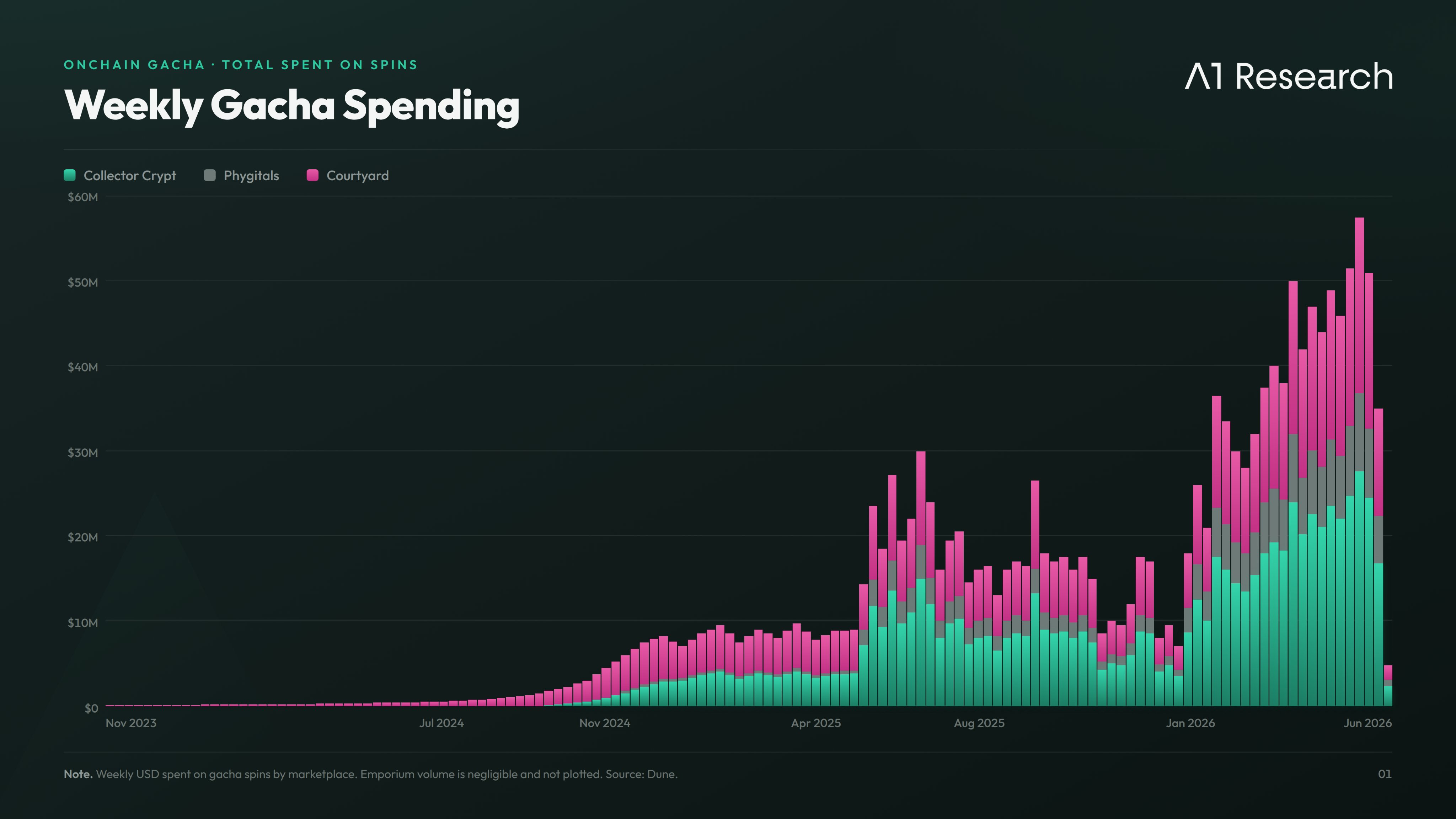
Gacha economics, what the numbers actually mean
Platforms advertise expected value slightly above cost: 'Pay $50, get $53 in value.' This is technically true based on fair market value of the card pool. But the vast majority of pulls are non-grail, non-highly-liquid cards. At the 85–90% buyback rate, the actual gross expected value typically runs at -2% to -3% per pull. The business model works because the gacha experience itself, the thrill of the pull, carries consumer value. This is not fundamentally different from physical pack opening, which has the same economics.
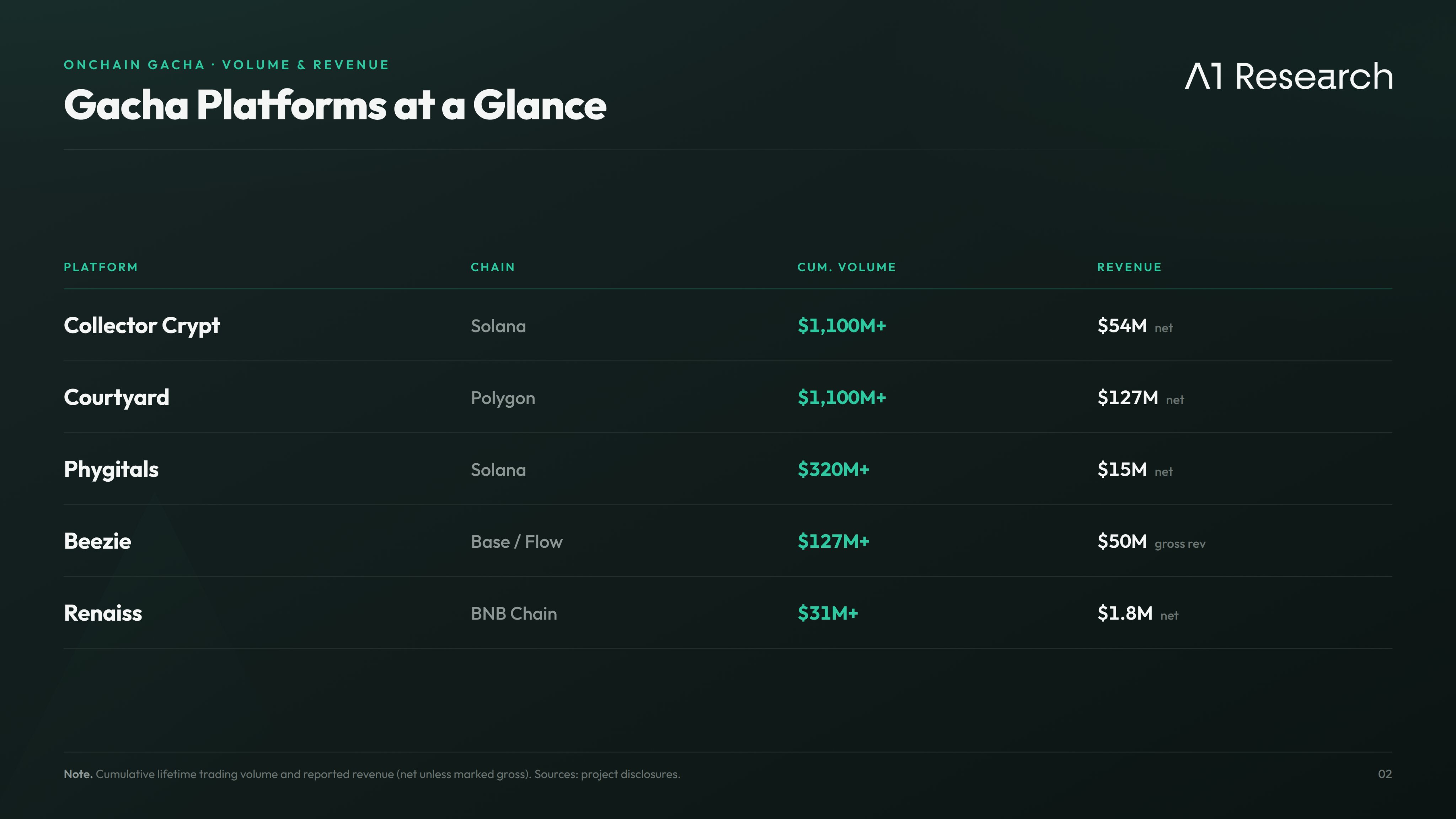
Solana currently holds approximately 50% market share in the on-chain TCG space, reflecting the sector's preference for fast, low-cost settlement rails in consumer-facing applications. The largest platforms by projected May 2026 gacha spend are:
6. The platforms, who is building what
Collector Crypt ($CARDS)
The largest marketplace by volume, built on Solana. Collector Crypt operates a $50 gacha system with average pull values slightly above cost and an 85% instant buyback system. The platform sources inventory through dealer relationships and a proprietary eBay sniping system that scans 3,000–4,000 auctions daily and acquires 100–150 cards per day below market price. It has processed over $1.1b in cumulative volume and generated $54 million in net revenue. Total gacha spending has reached $570 million.
One of the most interesting developments in the TCG space is the partnership between Loopscale and CollectorCrypt, which is the first time trading cards have functioned as collateral within a lending protocol. Through the integration, collectors can submit their vaulted card NFTs as collateral and borrow fixed-rate USDC against their collection, accessing liquidity without being forced to sell. It is a meaningful shift in what it means to hold a high-grade card, and while the traditional physical market offered two options (hold or sell) this adds a third: borrow against it and keep the asset. The infrastructure is early, but the proof of concept is live, and it represents the first real step toward what the sector is beginning to call Collectibles-Fi.
Backed by a $30 million Series A from Y Combinator, ParaFi Capital, and NEA, Courtyard runs on Polygon and positions itself as the infrastructure backbone of the sector. It combines tokenisation, vaulting, trading, and redemption into a single marketplace, and allows collectors to submit their own cards and earn 1% royalties on future sales, an incentive structure that continuously replenishes inventory. Assets are vaulted through Brink's. Fees sit around 6%, with a 90% instant buyback. The platform has processed over $1.1b in cumulative volume and $127 million in net revenue, and has ranked among the top NFT collections globally by weekly volume, outpacing CryptoPunks and Bored Apes.
Built on Solana with an entertainment-first approach, Phygitals recreates the experience of physical collecting through claw-machine interfaces and vending-machine style pulls. It has tokenised more than 100,000 cards and partnered with Fanatics Collect for inventory access. The platform has processed over $320 million in volume and generated over $15 million in revenue.
Built on Base and Flow, Beezie targets lower-cost participation with entry points starting at $30, the lowest in the sector. Assets are stored in Brink's-secured vaults with up to 90% instant buyback. Since launching in January 2026, it has generated over $127 million in trading volume and $50 million in gross revenue within its first three months.
Emerging platforms
A second tier is building quickly, Mnstr operates a shared treasury structure giving users collective exposure to rare Pokémon cards. Renaiss focuses on PSA-graded collectibles across sports cards, manga prints, K-pop memorabilia, and luxury items on BNB Chain. Rip.fun specialises in live physical pack openings streamed in real time, where pulled cards are immediately authenticated, vaulted, tokenised, and made tradable on-chain. PackflipNFT, RipRip, Dyli, and PlayKami are also accumulating early users. The sector is attracting new entrants rapidly, a function of the overall momentum and the relatively low barrier to replicating the core gacha model.
7. Three categories of on-chain collectibles
The on-chain market has expanded beyond Pokémon into three distinct segments, each with a different relationship to the financial infrastructure being built.
Traditional TCGs
Pokémon, One Piece, Yu-Gi-Oh!, Naruto, Marvel, and VeeFriends currently drive the majority of attention and trading volume. These categories attract collectors who already understand the asset, the on-chain layer reduces friction and adds programmability to behaviour they were already engaged in.
Sports cards
The most financially mature category in the space. Baseball, basketball, football, and soccer cards carry decades of price history and institutional-level valuations. Major authenticators graded 26.6 million cards in 2025, with sports cards accounting for 10 million of that total and PSA alone grading 19.26 million cards, a 26% year-over-year increase. High-end sales reflect the underlying scale: a one-of-one Mike Trout Superfractor autograph sold for $3.93 million in 2020. Unlike entertainment collectibles, sports cards already exist within an investment-oriented collector culture, making them particularly compatible with on-chain financial infrastructure.
Crypto-native 'Phygital' projects
A third category is emerging through projects that combine physical collectibles and blockchain systems from inception. The strongest example is Vibes TCG, developed by Orange Cap Games for Pudgy Penguins. Since launching in late 2024, Vibes has distributed more than 4 million cards and hosted over 350,000 matches, while sealed boxes have appreciated significantly on secondary markets. Unlike traditional collectibles being tokenised retroactively, projects like Vibes are building physical and digital ownership systems simultaneously from the ground up.
8. The addressable market and forward outlook
Market sizing for general TCGs varies depending on methodology and what's included, but the directional trend across every major research firm points the same way. Mordor Intelligence estimates the trading card game market at $14.7 billion in 2025, growing to $16.26 billion in 2026 and projected to reach $37.42 billion by 2034 at a CAGR of 10.98%. The exact number is less important than what the range signals: a market in structural expansion with a decade of documented trading behind it.
Against those figures, the on-chain layer is still in its infancy. Cumulative volume across the major platforms has crossed $2 billion, with May 2026 gacha spend at $200+ million monthly. Even at an annualised run rate approaching $2 billion in gacha spend alone, the on-chain segment represents a fraction of a percent of the total physical market. That gap is the structural opportunity, not a theoretical one, but one that is actively closing as each month sets a new volume record.
The broader RWA context reinforces the scale. Real-world asset tokenisation grew from roughly $5 billion in early 2025 to over $28 billion currently. Institutional participants including JPMorgan Chase, Franklin Templeton, and BlackRock are actively tokenising conventional financial instruments. Trading cards are something different: the culturally accessible, retail-native extension of the same structural transition. A $50 gacha pull on CollectorCrypt requires no understanding of wallets, NFTs, or blockchain mechanics, it only requires recognising what a Charizard card is. That creates a consumer onboarding path into real-world asset tokenisation that tokenised treasuries and private credit have struggled to achieve.
The financial utility layer compounds this. If high-grade cards with decades of transparent price history become accepted collateral within lending protocols at scale, collectors gain access to borrowing capacity against assets instead of being forced to liquidate them. The traditional physical market has never had this. An investor sitting on a PSA 10 Charizard today has two choices: hold it or sell it, on-chain infrastructure adds a third.
The TCG supercycle is currently being fuelled by a convergence of forces: broad cultural affinity for Pokémon and anime IP, gacha platforms buying graded slabs at scale, rip-and-ship operators buying physical packs, retail and institutional investors buying everything, and on-chain infrastructure making liquidity genuinely global. 2026 is also Pokémon's 30th anniversary year, with a major commemorative set release expected in September that the community is treating as a peak-mania catalyst.
9. Risks worth understanding
The growth is real but so are the structural risks.
The most immediate challenge is inventory supply. Premium collectibles, PSA 10 cards and rare graded assets are limited by nature. As more high-end inventory becomes locked inside vault ecosystems or delivered to customers, sourcing desirable cards becomes increasingly competitive and expensive. Long-term platform growth depends on maintaining a steady supply of premium inventory, and that becomes harder as adoption scales.
The grading layer introduces systemic risk. On-chain collectibles inherit their pricing legitimacy from PSA, BGS, and CGC. A PSA 10 card is only worth what PSA 10 means. The December 2025 PSA controversy which raised concerns around cards potentially being regraded following a buyback program highlighted how dependent the entire market is on confidence in that grading layer. Any loss of credibility at the grading level becomes a direct risk to on-chain asset prices.
Regulation remains an unresolved variable. As platforms expand into lending, fractional ownership, and collateralised financial products, tokenised collectibles could face increasing securities scrutiny across multiple jurisdictions. The more financialised the sector becomes, the more important regulatory clarity will be.
Finally, there is the cycle risk. The gacha mechanics that are driving volume growth are, at their core, gambling products. Consumer spending of this kind tends to be cyclical. The question of whether the current growth rate reflects durable structural adoption or an elevated speculative phase layered on top of genuine demand is not yet fully answerable. The honest answer is probably both.
10. Dynamic assets, a new primitive
Most of what has been described in this piece so far involves tokenising cards that already exist graded, vaulted, and represented on-chain. A new development takes the concept a step further: building a token that is not just backed by physical cards, but designed to systematically accumulate them as its core function. This is what Meteora, Sunrise DeFi, and Bedrock Foundation are calling a Dynamic Asset.
The first example is $SV151: a token offering fractional ownership of sealed Pokémon Scarlet & Violet 151 expansion packs. The structure is deliberately straightforward. The token launched on a flat-price bonding curve at a $200K market cap, targeting a $160K raise in USDC. That $160K goes entirely toward purchasing as many sealed SV151 packs as possible, no platform fees, no team allocation at launch. If the raise does not hit its target, participants can sell back for a full refund.
The team behind it
Three established Solana protocols are collaborating to make the structure work. Meteora is designing the liquidity mechanisms to rapidly create and bootstrap new Dynamic Assets. Bedrock Foundation acts as custodian of physical assets on behalf of the token community, functioning, in their framing, as the Bank of Internet Capital Markets. Sunrise DeFi acts as the primary distribution partner, ensuring tokens are tradable across every Solana venue. The combination is notable: a liquidity layer, a custody layer, and a distribution layer each handled by a specialist, rather than a single platform trying to do everything.
The flywheel
The $SV151 roadmap outlines three utility functions: collectors can deposit real SV151 packs with Bedrock and receive tokens in exchange; token holders can burn $SV151 to redeem physical packs from the reserve; and longer-term, the project aims to partner with card shops globally to accept $SV151 as payment. The long-term objective is explicit: corner the entire supply of SV151 by continuously accumulating packs through trading fees, depositor inflows, and open market activity.
The designed flywheel is: trading fees generate revenue → revenue buys more physical packs → stronger reserve backing → more demand for the token → more trading volume → more fees. If it works as designed, the token becomes self-compounding exposure to the underlying physical asset, not just a static wrapper around it. The token went to $3m FDV rapidly after launch, to now sit at an $800k valuation.
Why this is a different bet
Most on-chain collectibles platforms in part 6 are marketplaces: they earn fees on transactions, and their value accrues through volume and user growth. $SV151 is structurally different, it is not a marketplace, it is a treasury. Buying $SV151 is not a bet on trading volume, it’s fractional ownership of a physical inventory that is designed to grow over time, with a redemption mechanism that anchors the token to a real floor value. The distinction matters: the asset is the product, not the platform.
It also represents a genuine attempt to solve the problem that has plagued TCG markets for collectors outside the US and Europe: access. Today, buying specific sealed products requires navigating eBay, absorbing 13%+ fees, trusting unknown sellers, and managing international shipping. A token representing a vaulted reserve of the exact product you want, redeemable on demand, tradeable 24/7, DeFi-composable, is a materially better user experience for a global collector base of hundreds of millions.
The risks are real, the model depends on Bedrock Foundation maintaining custody reliably, this is still a trust assumption, not a self-custody solution. The secondary market value of the token is partially speculative and will fluctuate based on market conditions for SV151 product, not just the reserve value. And the ambition to corner the supply of a specific Pokémon set is an extraordinary goal that will test whether the flywheel holds under adverse conditions.
But as a proof of concept for what on-chain physical asset ownership can look like beyond a simple 1:1 card-to-NFT peg, it is one of the more interesting structural experiments the sector has produced. If $SV151 is the first Dynamic Asset, it is worth watching what comes next in that roadmap.
Conclusion: the lesson cards are teaching
Collectors do not buy assets, they buy meaning anchored in something real. They buy the feeling of pulling a card they have been chasing for months, the status of owning something their community recognises as rare. NFTs tried to manufacture that meaning through hype cycles and celebrity endorsements but trading cards built it through gameplay, storytelling, and thirty years of showing up.
On-chain TCG infrastructure does not need to create that demand from scratch, it is plugging into a century of it. Whether that makes the current cycle more durable than 2021 or simply a better-constructed speculative wave is the question the next 12 months will begin to answer.
Disclaimer: This content is for informational and educational purposes only and does not constitute investment, financial, or legal advice, or an offer to buy or sell any security or digital asset. Figures are point-in-time estimates reconciled from public sources and may be inaccurate or outdated. TCGs carry significant legal, liquidity, and counterparty risk, including total loss. Do your own research.
Share this research
A1 Team · General
More from A1 Research
View All ArticlesRead: Why Everything Is Becoming a Perp  General
Why Everything Is Becoming a Perp
Perpification is what happens when financial nihilism meets infrastructure that lets you lever anything, in a world that won't sit still.

 A1 Team, Sakshi17 min read
Read: Analyst Take: The Internet Is Learning How to Pay Itself and Crypto Is the Reason  General
Analyst Take: The Internet Is Learning How to Pay Itself and Crypto Is the Reason
Coinbase is building the AWS of agent commerce. AWAL + x402 + Stripe integration creates a full-stack moat on Base. Solana competes on speed, but integration depth will matter more than settlement time.
Sakshi, A1 Team6 min readRead: Zero: The Multi-Core Revolution or Maximum Hype?  General
Zero: The Multi-Core Revolution or Maximum Hype?
Zero introduces a heterogeneous "multi-core" architecture that separates execution (datacenter Block Producers) from verification (consumer-grade Nano Validators via ZK proofs), claiming 2 million…
A1 Team20 min read