Prediction Markets: The Path to $1 Trillion and What Needs to Happen Next
Analyzing the explosive growth, the infrastructure innovations, and the challenges that could define the next phase



This report was authored by @sakshimiishra
The Growth Story
The numbers are remarkable.
In 2024, prediction markets processed roughly $5 billion in total trading volume. By 2025, that figure surged to nearly $28–30 billion, marking an almost 6x growth in just one year.
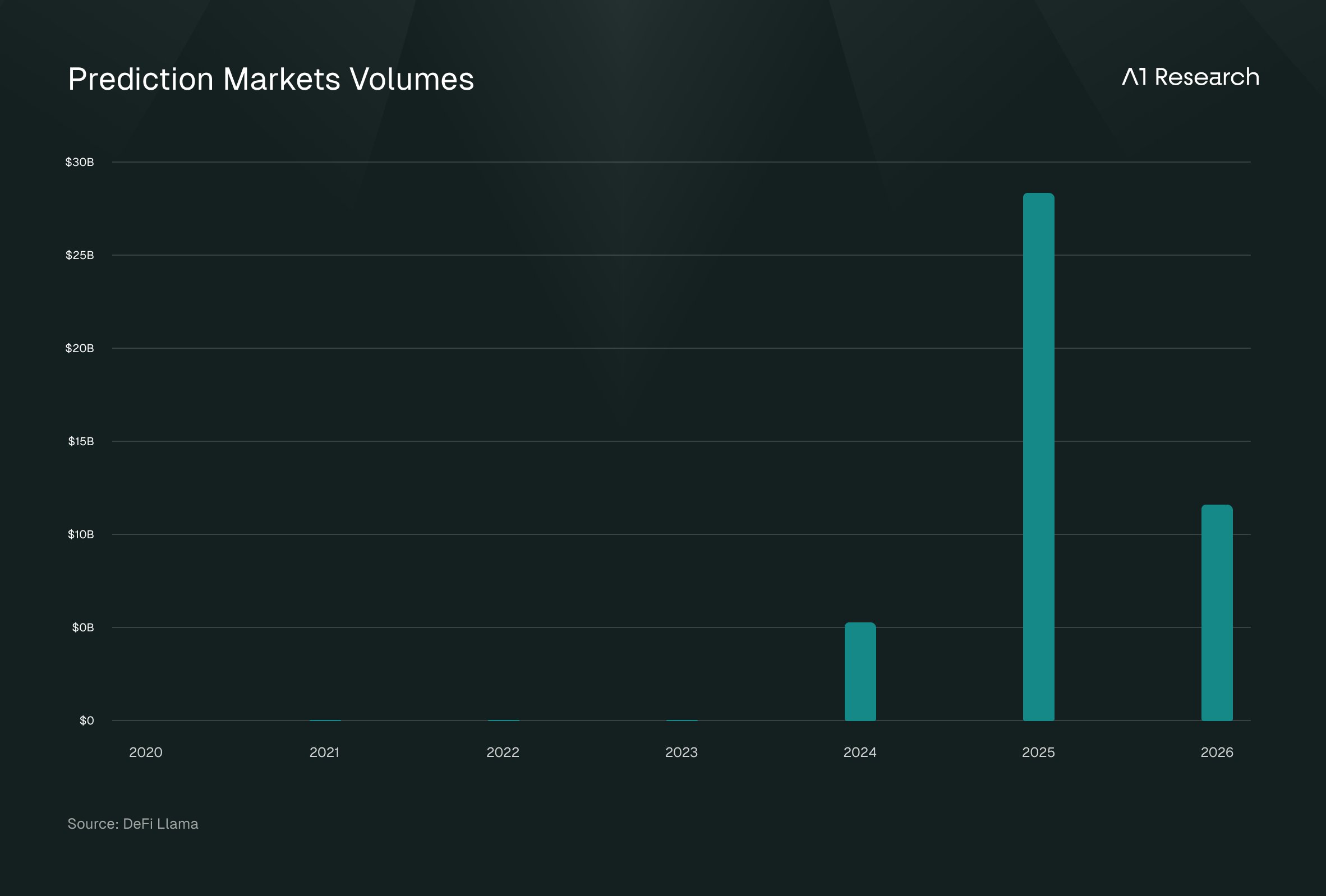
According to 2026 January volumes:
- Kalshi : $43 billion annualized volume
- Polymarket (crypto-based): $38billion volume
- Combined platform valuations: ~$20 billion
- Weekly trading volumes: $3.8-5.3 billion consistently
In 2024, the major growth started due to the US Presidential elections and it proved the concept at scale. Polymarket's election markets generated mainstream media attention, regularly featured on major news networks as a real-time sentiment indicator. Users discovered they could express views on outcomes that mattered to them and potentially profit from superior information or analysis and this is better than gambling (most of the time, at least).
Institutional capital validated the thesis by participating in the journey:
-
Intercontinental Exchange (ICE), the parent company of the NYSE invested $2B Polymarket, signaling serious institutional conviction.
-
Sequoia Capital, a16z, and Paradigm top-tier VCs with major stakes across the sector.
- Sequoia led Kalshi’s $1B Series E at an $11B valuation - Previously backed a $300M round at a $5B valuation - All three have also participated in Polymarket rounds.
-
Robinhood partnered with Kalshi to offer NFL, college football, and March Madness prediction markets, all running on CFTC-regulated rails.
-
Coinbase acquired Deribit for $2.9B to strengthen its derivatives infrastructure and launched native Coinbase Prediction Market (Feb 2026) for the U.S.based event trading.
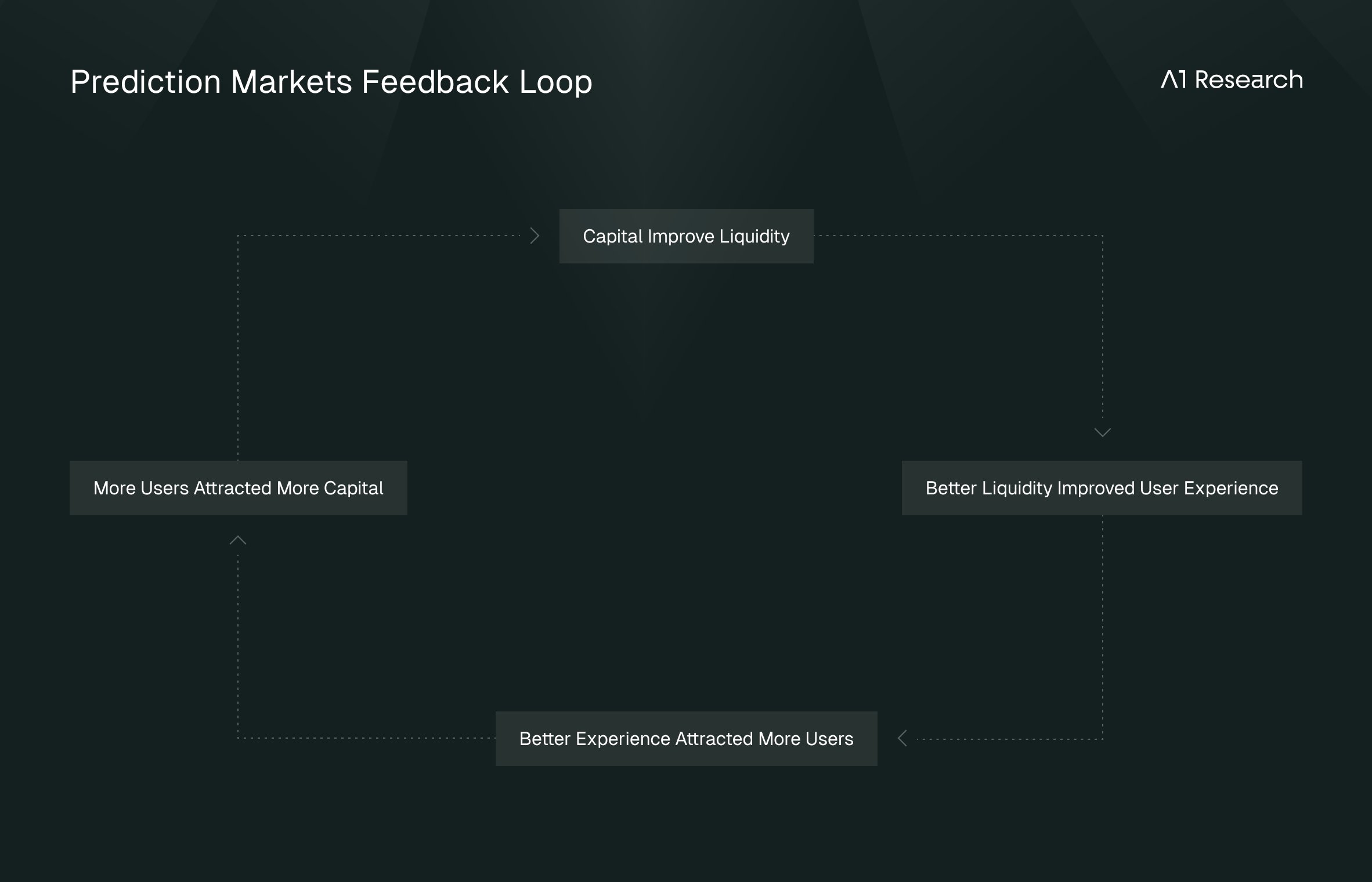
The feedback loop accelerated: capital improved liquidity, better liquidity improved user experience, better experience attracted more users, more users attracted more capital. Kalshi’s Cofounder has said multiple times that the Prediction Market sector is a trillion dollar market and it is not a far fetched thesis, the math is pretty straightforward.
The Math to $1 Trillion
The trillion-dollar thesis rests on prediction markets eating into several existing verticals simultaneously, not dominating any single one. The table above summarizes the addressable markets. Below is a bottoms-up framework for how capture rates across those verticals could compound.
Sports Betting:
Global sports betting generates roughly $125 billion in annual revenue today, projected to grow to $325 billion by 2035. The US segment alone accounts for $102 billion, with projections reaching $205 billion by 2032 at a 12.18% CAGR. Prediction markets are structurally advantaged over traditional sportsbooks in several respects: lower take rates, transparent on-chain settlement, and composability with DeFi infrastructure. In practice, however, they face steep disadvantages in user experience, brand recognition, and regulatory licensing relative to incumbents like DraftKings or FanDuel.
A realistic near-term capture rate is 5–10% of digital sports betting volume, rising to 15–20% over a decade as regulatory parity improves and cross-genre parlays (more on this below) create product differentiation that sportsbooks structurally cannot replicate. At the midpoint, that implies $12–25 billion in annual volume from sports alone.
Financial & Macro Event Hedging
The global OTC derivatives market carries approximately $964 trillion in total notional outstanding, but the vast majority sits in interest rate swaps between banks. The more relevant subset, risk management-focused financial derivatives, represents roughly $15 trillion in notional. Even this narrower figure overstates the addressable opportunity; notional outstanding reflects the face value of open contracts, not annual traded volume. The relevant comparison point is the subset of event-driven derivatives: binary options on rate decisions, earnings surprises, policy outcomes, and similar discrete events.
This segment is harder to size precisely because it doesn't exist as a standalone market yet. Prediction markets are creating it. Conservative estimates based on current institutional interest in event-driven hedging (corporate treasury use cases, macro fund positioning, insurance-adjacent products) suggest a $50–150 billion addressable volume opportunity as the category matures and regulatory frameworks enable institutional participation.
Emerging Categories
Weather derivatives currently represent a $25 billion market in notional terms, concentrated among energy companies and agricultural producers hedging seasonal risk. Prediction markets could expand access to smaller participants currently priced out of OTC weather contracts. Geopolitical risk hedging, technology milestone markets, and corporate earnings predictions represent additional greenfield categories with no direct incumbent, but also no proven demand curve yet. A reasonable estimate for emerging categories is $10–30 billion in the medium term, contingent on oracle infrastructure and regulatory clarity maturing in parallel.

Summing the Thesis
Combining conservative capture assumptions across these verticals (5-10% of sports, a fraction of event-driven financial derivatives, early traction in emerging categories) yields a floor of roughly $85-90 billion in annual volume. A base case with moderate capture rates and the addition of cross-vertical composability products, things like parlays linking an NFL result to a Fed rate decision that have no analogue in traditional infrastructure, pushes toward $150-200 billion. Third-party projections for prediction markets land at $95 billion+ by 2035 inclusive of corporate use cases, which broadly validates the conservative-to-base range.
Critically, the upside beyond sports betting comes from use cases that traditional sportsbooks and existing financial infrastructure structurally cannot serve. A logistics company concerned about hurricane disruptions could hedge against specific weather outcomes rather than buying broad catastrophe insurance. A semiconductor manufacturer worried about export restrictions could take positions in geopolitical event markets rather than relying on costly OTC structures. A VC fund could hedge against regulatory timelines for portfolio companies. These aren't speculative examples; they describe real risk management gaps that prediction markets are uniquely positioned to fill, and they are the foundation of the thesis that this sector eventually transcends entertainment betting entirely.
The trillion-dollar figure requires either substantially higher capture rates than modeled above, prediction markets becoming the default infrastructure layer for event-driven risk transfer broadly, or a breakout vertical we haven't anticipated. None of these are implausible. But framing $1 trillion as inevitable, rather than as the upper bound of a wide outcome distribution, understates the execution risk involved. Traditional sportsbooks took decades to build the product and trust necessary to reach $125 billion in annual volume. Financial derivatives required enormous regulatory clarity and institutional infrastructure to reach their current scale. Prediction markets are attempting to compete in both categories simultaneously while operating with crypto-native infrastructure that is less than three years old at scale.
The path from $30 billion to $180 billion is a product execution problem. The path from $180 billion to $1 trillion is a market structure transformation. Both are worth tracking separately.
The gap between "addressable" and "captured" is real, but the answer is already emerging through product innovation. The platforms processing $30 billion+ in current volume are not standing still; they are shipping features specifically designed to unlock the next order of magnitude.
The Innovation Wave: New Features Driving Adoption
Parlays: Unlocking Combination Bets
In December 2025, Kalshi launched "Combos" allowing users to combine multiple predictions into single positions and the first week of volume with Parlays crossed $100M+
The numbers make sense. Traditional sportsbooks generate over 50% of revenue from parlays (Source: Eilers & Krejcik Gaming). Users are drawn to:
- Higher potential payouts from smaller stakes
- The ability to express complex, multi-factor views
- More engaging experience than single-event betting
Prediction markets offer unique structural advantages here. Unlike sportsbooks constrained by regulatory silos, prediction markets can offer cross-genre parlays:
- NFL playoff outcomes + Federal Reserve rate decisions + Bitcoin price targets
- Company earnings results + sector performance + macroeconomic indicators
- Political election outcomes + policy implementation + market reactions
This flexibility creates entirely new product categories unavailable through traditional financial or betting infrastructure.
Leverage: The Technical Challenge
Multiple platforms have announced leverage products, with some targeting 10-20x. The implementation, however, requires solving unique technical problems.
Traditional leverage works because liquidation systems have time to act. If a stock position moves against you, the exchange can close it before losses exceed collateral even if that window is just seconds.
Prediction markets often lack this time buffer. Events can resolve instantly: a presidential announcement, a central bank decision, a regulatory ruling. Price can gap from 95 to 5 (or vice versa) with no intermediate states. This "gap risk" fundamentally distinguishes prediction markets from traditional leveraged instruments.
In traditional markets: Information diffuses gradually. Even breaking news creates sequential price levels (95 → 92 → 88 → 85). Liquidation engines have microseconds to react.
In prediction markets: Binary outcomes mean discontinuous jumps. When an event resolves, price doesn't gradually move it gaps directly to 0 or 100. No liquidation window exists.
The challenge compounds through "toxic flow." In his November 2025 analysis on "Adverse Selection in Prediction Markets," Kaleb explains:
"Gap risk is effectively worse for prediction markets than for any other class, because a highly toxic counterparty can be so informed that they have effectively perfect information against you, like if you were playing poker against someone who can see your hand."
Real example: Eric Adams NYC mayoral market. Insiders with knowledge of his withdrawal decision took out the entire orderbook before the public announcement. The price gapped 30+ cents instantly. Liquidity providers had no hedge, no exit, just immediate losses.
This is why most platforms don't offer traditional leverage. The math doesn't work when resolution can happen instantly with perfect information asymmetry.
This explains why the emerging solutions focus on fundamentally restructuring the problem
The Emerging Solutions:
Continuous settlement models: Platforms like Seda are building perpetual futures based on real-time data feeds (polling averages, odds movements, sentiment scores) rather than binary outcomes. This creates liquidation opportunities before final resolution.
Short-duration binary options: Limitless offers crypto price predictions over hours or days rather than weeks. Faster resolution cycles reduce gap risk while providing leverage-like payoff structures.
Epoch-based pricing: As outlined in recent research by Kaleb, platforms can price risk in short time windows with rolling fees (similar to perpetual futures funding rates), separating gradual price movements from instant jumps.
These innovations are maturing. Polymarket partnered with Chainlink in September 2025 to launch 15-minute crypto price markets. Hyperliquid proposed "Event Perpetuals" where traders can profit from probability changes without waiting for final resolution.
Outcome-based trading primitives: Hyperliquid is developing HIP-4, a novel approach that sidesteps the leverage problem entirely. Instead of traditional leveraged positions, HIP-4 introduces "outcomes" of fully collateralized contracts that settle within fixed ranges without leverage or liquidations.
From Hyperliquid's technical specification:
"Outcomes are fully collateralized contracts that settle within a fixed range. They are a general-purpose primitive that are useful for applications such as prediction markets and bounded options-like instruments... Outcomes bring non-linearity, dated contracts, and an alternative form of derivative trading that does not involve leverage or liquidations."
The approach is architecturally different from traditional prediction markets. Rather than creating binary yes/no markets with leverage layered on top, outcomes are designed from the ground up to provide non-linear payoffs without the liquidation risk that makes traditional leverage unworkable.
Currently in testnet, HIP-4 will initially deploy "canonical markets based on objective settlement sources" before potentially expanding to permissionless deployment based on user feedback. The markets will be denominated in USDH and compose with Hyperliquid's existing infrastructure like portfolio margin and the HyperEVM.
Hyperliquid already operates the second-largest perpetual futures ecosystem. Even if HIP-4 captured 100% of Polymarket's current volume (~$33B annually), it would represent approximately 5% incremental revenue. This suggests Hyperliquid views prediction markets not as a primary revenue driver but as an expansion of their derivatives primitives betting that outcomes and prediction markets will eventually scale beyond current crypto-native platforms.
If a platform with Hyperliquid's liquidity infrastructure and user base successfully launches prediction markets, it could validate the model at institutional scale.
The technical infrastructure is evolving to support leverage safely, though it requires fundamentally different architecture than traditional margin systems.
The Growth Catalysts Ahead
2026 represents a crucial year for validation:
June 2026: FIFA World Cup
- Projected $50-100 billion in potential prediction market volume
- First major global sporting event since infrastructure matured
- Tests cross-border liquidity, settlement systems, and user experience at scale
November 2026: US Midterm Elections
- Largest prediction market event in history (based on 2024 presidential election data)
- Mainstream media will cover prediction market odds as leading indicators
- Proves long-term viability beyond single-event spikes
Ongoing Regulatory Progress:
- State-by-state legal battles (Nevada, Massachusetts, New York) approaching resolution
- CFTC framework development for regulated prediction markets
- International jurisdictions establishing clearer guidelines
If prediction markets successfully handle these volume spikes with good user experience, institutional adoption will accelerate significantly.
The Infrastructure Challenges
Growth at this pace surfaces infrastructure gaps that the sector must close to sustain its trajectory. Five interconnected problems stand between current volumes and the next order of magnitude, and each is being actively addressed, though none are fully solved.
1. Liquidity Depth and Sustainability
Current model: Platforms incentivize professional market makers to provide liquidity through rebate programs and direct payments.
The numbers:
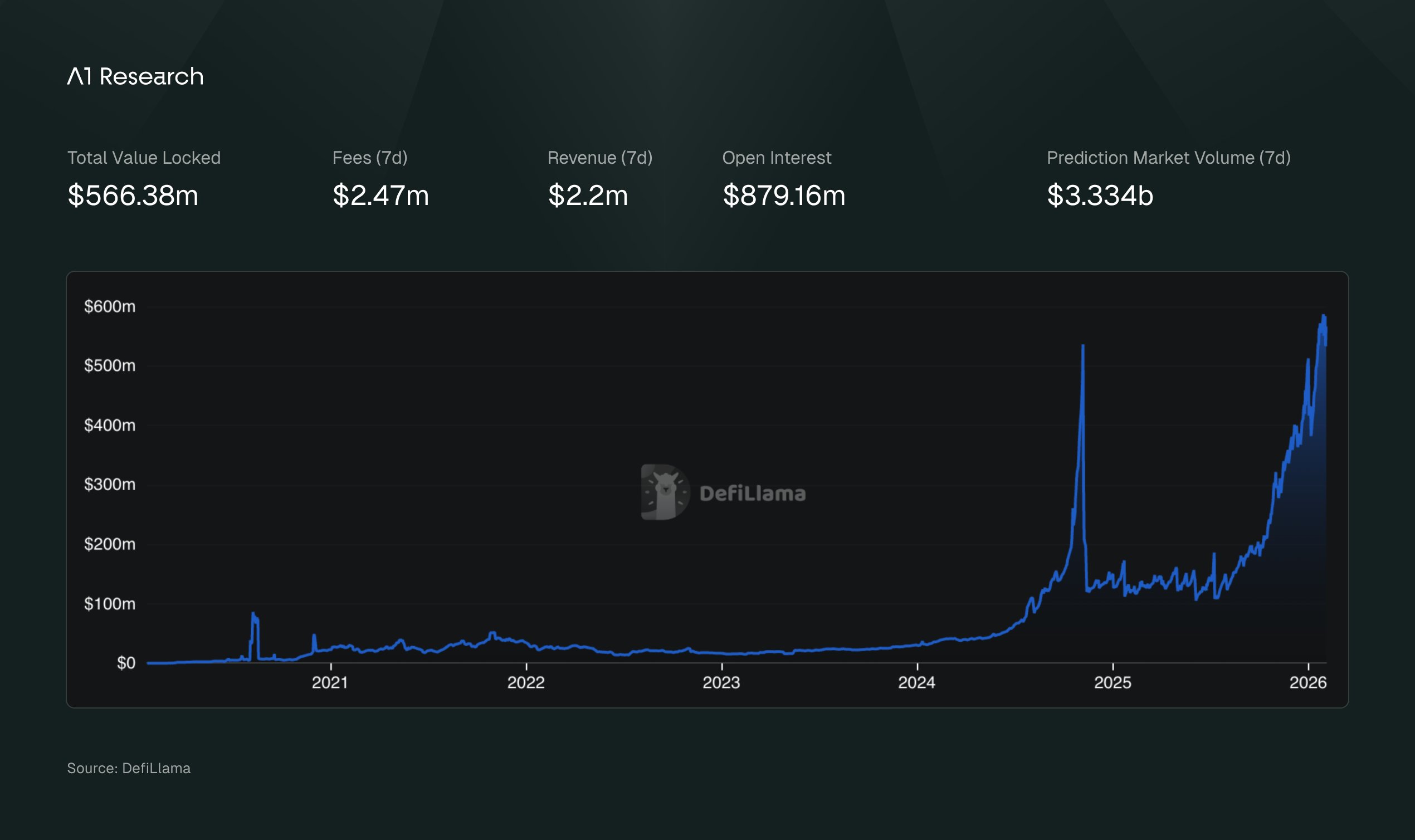
- Total Value Locked across prediction markets: $581 million (DeFiLlama)
- Daily fees generated: $524,000
- Market maker incentive spending: Platforms have invested heavily (Polymarket ~$10M, Kalshi ~$9M)
But there is a challenge**,** as Nick Ruzicka noted in his October 2025 analysis, early incentive rates ($50,000+ daily) have normalized to sustainable levels ($0.025 per $100 traded). This creates a question: can liquidity provision become self-sustaining through fee revenue alone?
Promising developments:
Several developments suggest the transition to self-sustaining liquidity is underway. On the institutional side, Kalshi's onboarding of Susquehanna International Group in April 2024 delivered a 30x liquidity increase and compressed spreads to sub-3¢, a proof point that institutional market makers can transform venue quality when the regulatory and commercial framework justifies their participation. As prediction markets gain legitimacy, additional institutional entrants are likely.
On the structural side, platforms are experimenting with quality-weighted rebate models that reward consistent, high-quality liquidity provision rather than raw volume, better aligning incentives between venues and their market makers.
Hybrid Liquidity Provider (HLP) models (conceptually similar to GMX's GLP vaults) allow retail participants to provide liquidity collectively while professional managers handle risk, broadening the capital base beyond dedicated trading firms.
Just-in-time (JIT) liquidity, where sophisticated bots inject capital precisely when needed for large trades and withdraw immediately after, has already proven successful on Uniswap V3 (facilitating over $750 billion in volume) and represents a viable model for prediction market venues facing intermittent demand spikes.
The transition from subsidized to self-sustaining liquidity is underway. As volumes grow and fee revenue increases, the economics improve for professional liquidity providers.
2. Discovery and User Experience
With thousands of active markets, helping users find relevant opportunities becomes critical.
Current fragmentation:
- Polymarket: Thousands of live markets at any time
- Kalshi: Hundreds of markets across sports, politics, economics
Volume concentrates on flagship markets (elections, major sports, trending crypto), while long-tail markets struggle for attention.
Innovative solutions emerging are emerging to solve these exact issues:
Aggregation platforms - TradeFox and Verso Trading are building unified interfaces that aggregate markets across multiple platforms, route orders to best execution, and integrate real-time news.
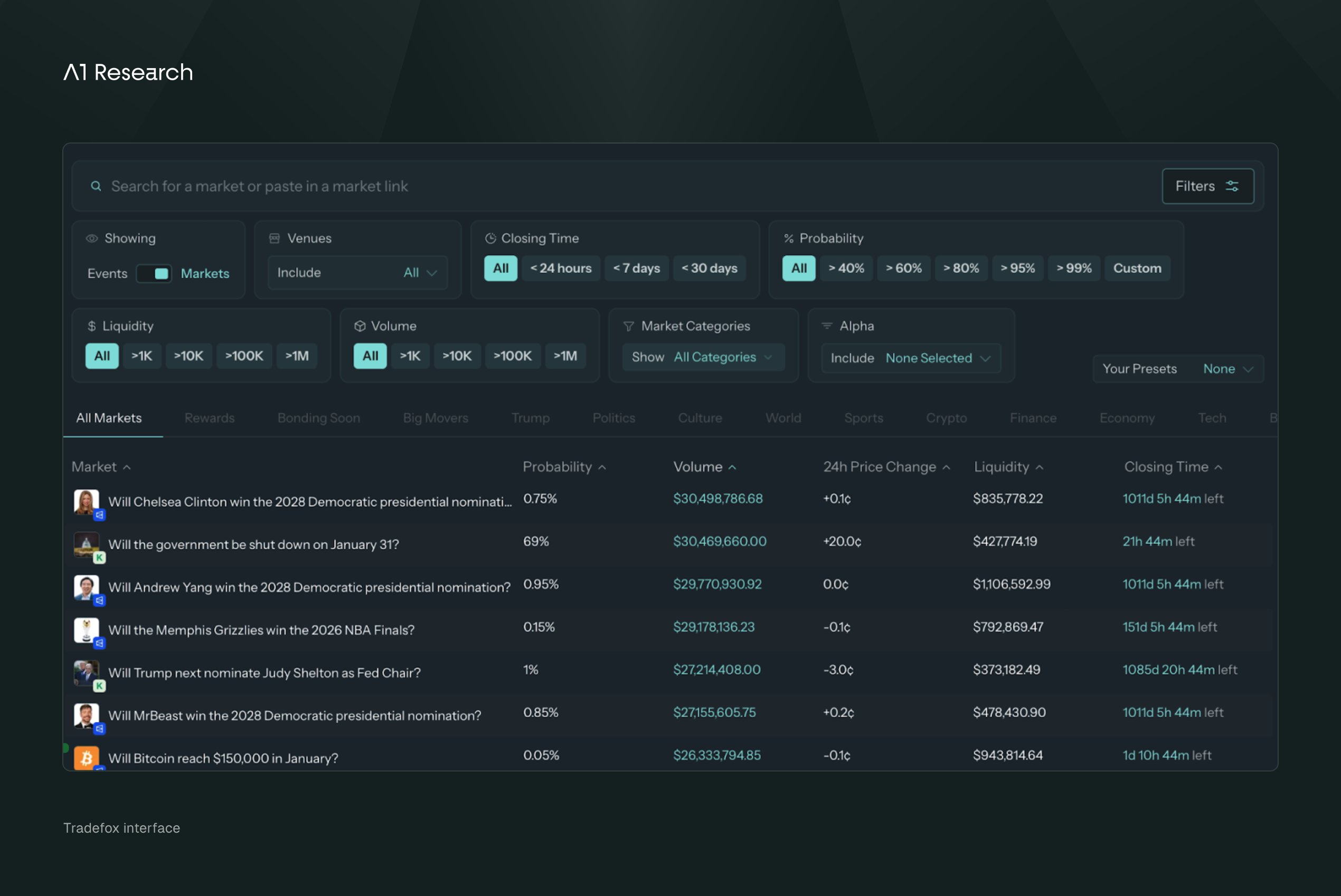
Community-driven markets - Fireplace focus on social prediction markets among friend groups, creating organic discovery through existing social networks. A social layer on top of Polymarket and Kalshi, using chain abstraction with Socket Protocol to seamlessly aggregate both markets.
Distribution matters more than infrastructure for reaching mainstream users. Platforms that integrate into existing workflows (social media, news apps, trading terminals) will capture users more effectively than standalone destinations.
3. Trade Expression Capabilities
Sophisticated users remain constrained by the limited expressiveness of current platforms. Leverage options are nascent (as discussed above), parlay functionality is still maturing, conditional order types (e.g., "buy X if Y resolves first") are largely absent, and most markets offer only binary outcomes with no continuous range trading. These limitations restrict the complexity of views that traders can express and cap the utility of prediction markets for institutional hedging strategies that require nuanced position construction.
Emerging innovations:
Continuous outcome markets: Instead of discrete yes/no, platforms like functionSPACE are testing markets across continuous ranges (e.g., "Bitcoin price at year-end" traded as a range rather than specific strikes).
Bonding curve models: Melee Markets applies bonding curves to prediction markets where early participants get better prices, creating market-making through game theory rather than professional intermediaries.
Creator-seeded liquidity: XO Market requires creators to provide initial liquidity using LS-LMSR AMMs, aligning incentive between market quality and creator revenue.
These experiments expand what's possible beyond simple binary bets, enabling more sophisticated strategy expression.
4. Permissionless Market Creation
The fundamental tradeoff in market creation is between curation and openness. The curated approach (used by Polymarket and Kalshi, where platform teams approve all markets), ensures quality but creates bottlenecks and inevitably misses time-sensitive opportunities. The permissionless approach, where anyone can create a market, solves the speed problem but introduces semantic fragmentation, liquidity splitting across duplicate markets, and low-quality spam that potentially degrades the user experience.
Hybrid models emerging:
Pump.fun-style mechanics - Melee gives creators 100 shares, early buyers declining allocations (3, 2, 1 shares). If the market gains traction, early participants profit. This creates organic quality filtering only markets with genuine interest survive.
Reputation-weighted curation - Users stake reputation tokens when proposing markets. Community votes determine which go live. Good curators earn rewards, bad curators lose stake.
The technical infrastructure for permissionless creation exists. The challenge is designing incentive systems that maintain quality without centralized gatekeeping.
5. Oracle Resolution
Who determines what actually happened? This remains the foundational challenge.
Current approach - Multi-tier resolution:
Tier 1: Automated data feeds: Objective outcomes (crypto prices, sports scores) settle instantly via oracle networks like Chainlink
Tier 2: AI verification: Chainlink research showed AI oracles achieved 89% accuracy on 1,660 Polymarket markets (99.7% on sports). Supra's Threshold AI Oracles use multi-agent committees with cryptographic verification.
Tier 3: Optimistic oracles: UMA's system allows anyone to propose outcomes with a challenge period. Disputes escalate to token-holder votes. Game-theoretic design ensures honest resolution is economically rational.
Tier 4: Human committees: For ambiguous cases requiring judgment, platforms use vetted committees or DAO votes.
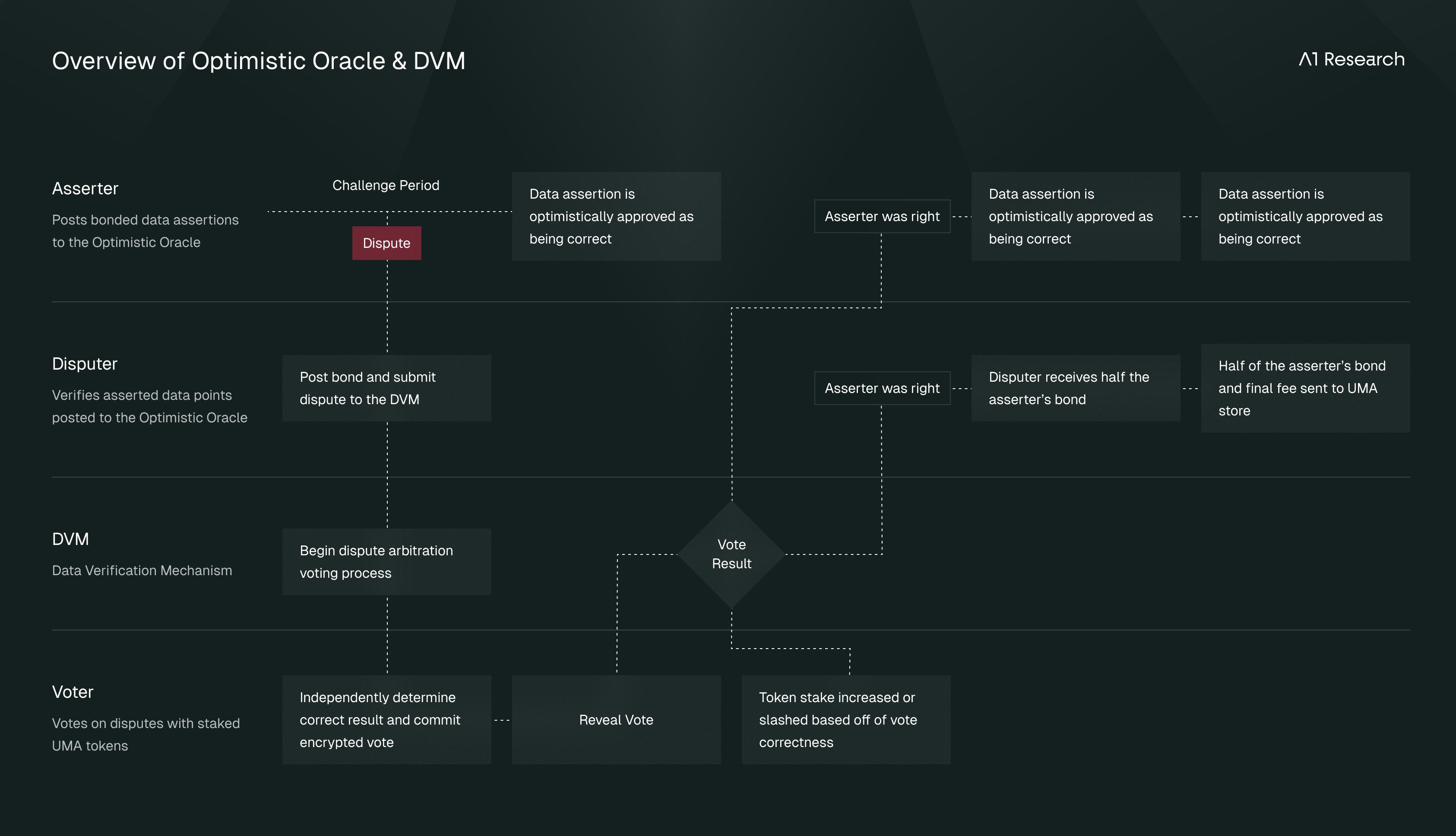
The maturation path:
As AI improves and oracle networks expand coverage, more markets will resolve automatically (Tiers 1-2). Human intervention (Tiers 3-4) will increasingly handle only genuinely ambiguous edge cases.
Polymarket's September 2025 Chainlink integration demonstrates this evolution as a 15-minute crypto market now settled instantly with zero human intervention.
The infrastructure is getting better, not worse.
Risks and Bear Cases
The bull case for prediction markets is well-articulated by now, and largely priced into the $20 billion+ in platform valuations. The risks deserve equal analytical rigor.
Regulatory Reversal
The current trajectory assumes continued CFTC accommodation and state-level licensing progress. This is not guaranteed. The CFTC's 2024 engagement with Kalshi followed a contentious legal battle (Kalshi v. CFTC, D.C. Circuit) that the agency lost on narrow procedural grounds, not because the Commission endorsed event contracts broadly. A change in CFTC leadership, a high-profile market manipulation scandal, or political pressure following a controversial market outcome could trigger a restrictive rulemaking cycle. State attorneys general in New York and Nevada have already signaled skepticism toward prediction markets operating without gaming licenses.
For crypto-native platforms like Polymarket operating outside US jurisdiction, regulatory risk manifests differently: potential enforcement actions against US-based users, banking partner withdrawal, or stablecoin regulatory tightening that disrupts settlement infrastructure.
Post-Event Volume Collapse
The 2024 presidential election cycle demonstrated both the ceiling and floor of event-driven volume. Polymarket's daily volumes surged above $300 million in the weeks before the election, then contracted sharply once the outcome resolved. The 2025 recovery was driven substantially by sports betting markets and crypto price speculation rather than sustained demand for the "information discovery" use case that prediction market advocates emphasize.
If the pattern repeats (volume spiking around the 2026 World Cup and midterms, then contracting) it would suggest prediction markets are event-dependent rather than structurally sticky. The key metric to watch is baseline volume between major catalyst events. If inter-event volumes remain below $500 million weekly through 2026, the market structure transformation thesis weakens considerably.
Market Integrity and Manipulation
The Eric Adams mayoral market episode is instructive but not isolated. Prediction markets are inherently exposed to information asymmetry, and unlike securities markets, they lack comprehensive insider trading frameworks, surveillance programs, or enforcement mechanisms. As markets grow, the incentive to manipulate outcomes, or trade on material non-public information, scales proportionally.
Oracle manipulation represents a related vector. The multi-tier resolution systems described above are sophisticated but largely untested at scale under adversarial conditions. A high-profile resolution dispute (imagine a contested election outcome or ambiguous geopolitical event) that erodes user trust in settlement integrity could set adoption back materially.
Liquidity Fragmentation
Current volumes are concentrated across two dominant platforms (Polymarket and Kalshi) with fundamentally incompatible infrastructure: on-chain vs. off-chain, crypto-native vs. regulated US entity. As additional entrants launch (Hyperliquid's HIP-4, various permissionless protocols), liquidity risks fragmenting across venues rather than consolidating. In traditional markets, this problem was solved through interoperability standards and clearing infrastructure that took decades to build. Prediction markets have no equivalent yet.
A1 View: Where We Stand
The prediction market sector has achieved genuine product-market fit. That much is no longer debatable. The progression from $5 billion in 2024 to $30 billion in 2025 reflects organic adoption, not subsidized growth, and the institutional capital entering the space is deploying against real commercial thesis rather than speculative positioning.
The infrastructure innovations underway (continuous settlement models, cross-genre parlays, outcome-based trading primitives, institutional-grade liquidity provision) are directionally correct solutions to the right problems. The question is execution speed relative to the competitive window.
Three specific metrics will determine whether the sector reaches escape velocity or plateaus:
1. Inter-event baseline volume. If weekly volumes sustain above $1 billion between the 2026 World Cup and midterms, the structural demand thesis holds. Below $500 million, the sector remains event-dependent.
2. Institutional liquidity participation. Susquehanna's entry into Kalshi was a meaningful signal. If two or more additional institutional market makers commit to prediction market venues by the end of 2026, spread compression and depth improvements will compound adoption.
3. Regulatory milestones. Specifically: at least one additional US state granting explicit prediction market licensing, and CFTC issuance of a proposed rulemaking framework for event contracts. Without these, the category remains in regulatory limbo that constrains institutional adoption.
The 2026 World Cup (June through July) and US midterms (November) will stress-test infrastructure, liquidity, and user experience simultaneously across the two largest event categories. The performance during, and critically after, these events will provide the clearest signal yet on whether prediction markets are building toward a new financial primitive or cycling through another hype-driven vertical.
Our base case: the sector reaches $100–200 billion in annual volume by 2028, driven primarily by sports betting capture and nascent financial hedging use cases. The trillion-dollar outcome requires structural shifts in regulation and institutional adoption that are plausible but not yet in motion. We will revisit this framework after the 2026 midterm cycle.
Data sources: DeFiLlama, BIS Derivatives Statistics (H1 2024), Delphi Digital (Neel Daftary, October 2025), Nick Ruzicka analysis (November 2025), Kaleb research (November 2025–January 2026), Eilers & Krejcik Gaming, Chainlink research publications, CFTC public filings, and platform announcements.
Share this research
A1 Team, Sakshi · DeFi
More from A1 Research
View All ArticlesRead: Ethereum’s Scaling Experiment: What Worked, What Didn’t, and What Comes Next  DeFi
DeFiEthereum’s Scaling Experiment: What Worked, What Didn’t, and What Comes Next
In February 2026, a single post by Vitalik Buterin set the Ethereum ecosystem on fire. The rollup-centric roadmap the architectural vision that had defined Ethereum's scaling strategy for half a decade needed to…

 A1 Team, Sakshi25 min read
Read: Perp DEX Wars: The $8 Trillion Institutional Endgame  DeFi
DeFiPerp DEX Wars: The $8 Trillion Institutional Endgame
Hyperliquid leads at 67/80 under our institutionally-weighted scorecard, reflecting dominance in volume, ecosystem breadth, and builder adoption, while October 10 exposed concrete limits: $2.1B closed via ADL in 12…
 A1 Team, ZeroKnowledge68 min read
Read: Paradex: Private Institutional-Grade Trading at Internet Scale  DeFi
DeFiParadex: Private Institutional-Grade Trading at Internet Scale
In the current decentralized trading landscape, every institutional trader pays a hidden "Visibility Tax." When position sizes, entry points, and liquidation levels are broadcast to public mempools, sophisticated…
A1 Team, ZeroKnowledge31 min read