Front-Running the IPO: The $10 Trillion Pre-IPO Market Comes On Chain
OpenAI and Anthropic called the private share tokens "void." Yet they're still trading and the on-chain market priced Anthropic's $965B round before the term sheet was signed. The issuer veto is the filter.

Key Takeaways
- The mega-IPO window is closing, and the deadline is repricing everything. SpaceX filed its S-1 on May 20 (targeting $1.75–2T, ticker SPCX, trading expected June 12), Anthropic confidentially filed for IPO on June 1 on the back of a $965B Series H, and OpenAI is racing to list first. The private window that crypto spent all of 2025 tokenizing is shutting and that countdown, not the hype, is what's driving the bid.
- On-chain markets are no longer downstream of private valuations; they front-run them. Tokenized and perp venues implied a $1T+ valuation for Anthropic weeks before its $965B Series H confirmed the mark. For an asset class with no public quote and 90-day-stale 409As, crypto has quietly become the real-time price-discovery layer.
- The valuation "gaps" are far smaller than the headlines suggest. Measured against each company's latest priced round, tokenized proxies trade at roughly +35% (Anthropic), +6% (OpenAI), and +20% (SpaceX). Those are premiums, not hallucinations, for names compounding ~2.5x a quarter.
- The issuer veto is real but narrow. Anthropic's "void" doctrine kills unauthorized SPV transfers the model behind PreStocks and Jarsy but has zero legal purchase on synthetic perpetuals (Ventuals, OKX, Hyperliquid) that never touch a share. The category is already migrating toward the structures the veto cannot reach.
- Backing transparency is the genuine risk and it's a crypto-native one to fix. PreStocks' dashboard implied a >$1.3T Anthropic valuation against roughly $23M in assets actually held. That mismatch surfaced publicly on-chain within days, versus the years the same flaw stayed hidden inside Linqto before its collapse.
- The endgame is issuer-native issuance. Galaxy and SharpLink already issue tokenized stock carrying the same CUSIP as their listed shares, and the SEC has confirmed that an on-chain registry does not change the legal analysis. For the AI labs, the question is no longer whether their equity gets tokenized, it's whether they capture that flow or keep litigating against it.
Methodology
Valuation and on-chain figures in this report reflect a snapshot as of June 3, 2026, reconciled across primary disclosures (company announcements, SpaceX's S-1), tier-one financial reporting (Bloomberg, TechCrunch, Axios, Fortune, Al Jazeera), crypto-native coverage (CoinDesk, The Block), and platform documentation (PreStocks, Ventuals/Hyperbeat, Bitget, Jarsy). Implied valuations on tokenized and perp venues are inherently volatile and vary by platform, token series, share-count assumptions, and FX; where sources conflict, we flag the range rather than pick a number. Private "last round" anchors use the most recent closed, priced round, not press-reported offers. Nothing here is investment advice.
1. The $10 Trillion Inflection Point
The most valuable companies of this generation are ones you're not allowed to own, priced by a number that's wrong on purpose. That single gap is why this entire market exists.
If you're a regular investor, the private market is a locked room. You need to be accredited, write a check in the tens or hundreds of thousands, pay steep fees, and then sit through a lockup that runs a year or more. And even the "official" price is fiction: a company's internal 409A valuation, the one used to price employee options, is deliberately lowballed to cut employees' taxes and only updates every few months. So the posted number is both stale and intentionally too low. No way in, and no honest price to point to.
Crypto walked straight into that vacuum. Over the past year three different products appeared to sell ordinary people a slice of the action: tokens backed by a shell company that actually holds the shares, perpetual futures that just track a company's valuation without touching a share, and regulated notes that pay out based on the IPO. Suddenly you could get OpenAI exposure for ten dollars at two in the morning, no accreditation required.
Then the companies fought back. In May, OpenAI and Anthropic declared the structures behind many of these tokens "void", warned they may be worthless, and the tokens dropped 40% in a week. Which raises the question this piece is built to answer: are these things fake and finished, or did the issuers just hand the market a map?
Because here's the irony underneath it all. Crypto spent a year building a side door into these companies right as the front door is about to open. SpaceX filed on May 20 to go public aiming for $1.75–2T and a raise of up to $75B, with trading expected late June under SPCX. Anthropic filed June 1, days after a round that valued it at $965 billion. OpenAI is racing to beat it to the bell. The clock running down on that private window is what's pushing people into the tokens now: the last chance to be early before the IPO makes all of it ordinary.
2. The Three Doors (and the Fourth)
There is no single "tokenized pre-IPO stock." There are four structurally distinct instruments, and conflating them is the most common analytical error in space. They differ on one axis that determines everything downstream: how close the instrument sits to a legal claim the issuer recognizes.
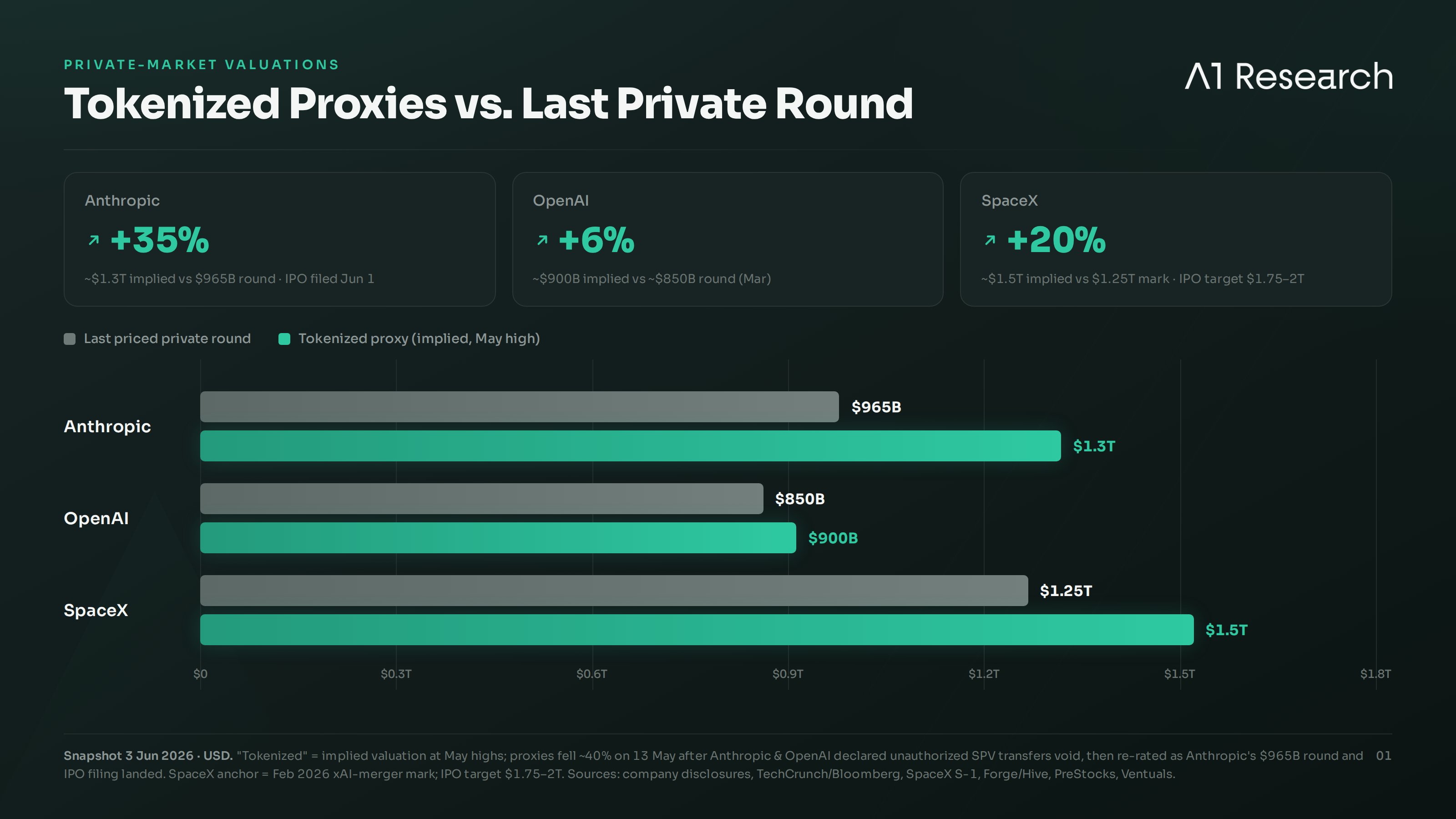
Door 1 — SPV-backed tokens (custodial). A Special-Purpose Vehicle (SPV) buys and holds the shares; the platform mints tokens representing indirect economic exposure to that SPV. PreStocks (Solana, via Jupiter and Meteora; launched August 2025, backed by Republic Capital) and Jarsy (a 1:1 model via a Delaware LLC, from a $10 minimum, $5M pre-seed led by Breyer Capital) are the archetypes. The pitch is "real backing." The vulnerability is that the underlying transfer depends on the issuer's consent and, as we'll see, that consent is exactly what's being withheld.
Door 2 — Synthetic perpetuals. No shares, no SPV, no custody. A perpetual future settles in USDC against an oracle-fed valuation. Ventuals, built on Hyperliquid's HIP-3 standard and backed by Paradigm, is the leading venue, joined by OKX, Gate, Lighter, and TradeXYZ. Ventuals quotes a "Valuation Unit" equal to the company's total valuation in billions (a price of 965 means a $965B mark), blends an off-chain data feed (Notice) with an eight-hour moving average of the perp itself, and runs liquidity through a community VLP vault (currently a $30M cap, audited three times). It offers no ownership and pretends to none. That honesty is its structural strength.
Door 3 — Structured notes (regulated). A debt-like instrument tied to IPO performance, issued under a formal exemption. Bitget's preSPAX, built on Republic, is the model: 94,000 tokens at $650 each (an implied ~$1.5T SpaceX mark at subscription), distributed under a Reg CF framework with a $5,000 cap and one-year lock-up. The materials are explicit that buyers receive no equity, debt, or contractual claim against SpaceX. It is compliant precisely because it gives you the least.
Door 4 — Issuer-native issuance. The company itself mints the token as the share of record. Not yet available for any private AI lab but already live for public companies, and the only door that fully resolves the ownership question. We return to it in Section 7.
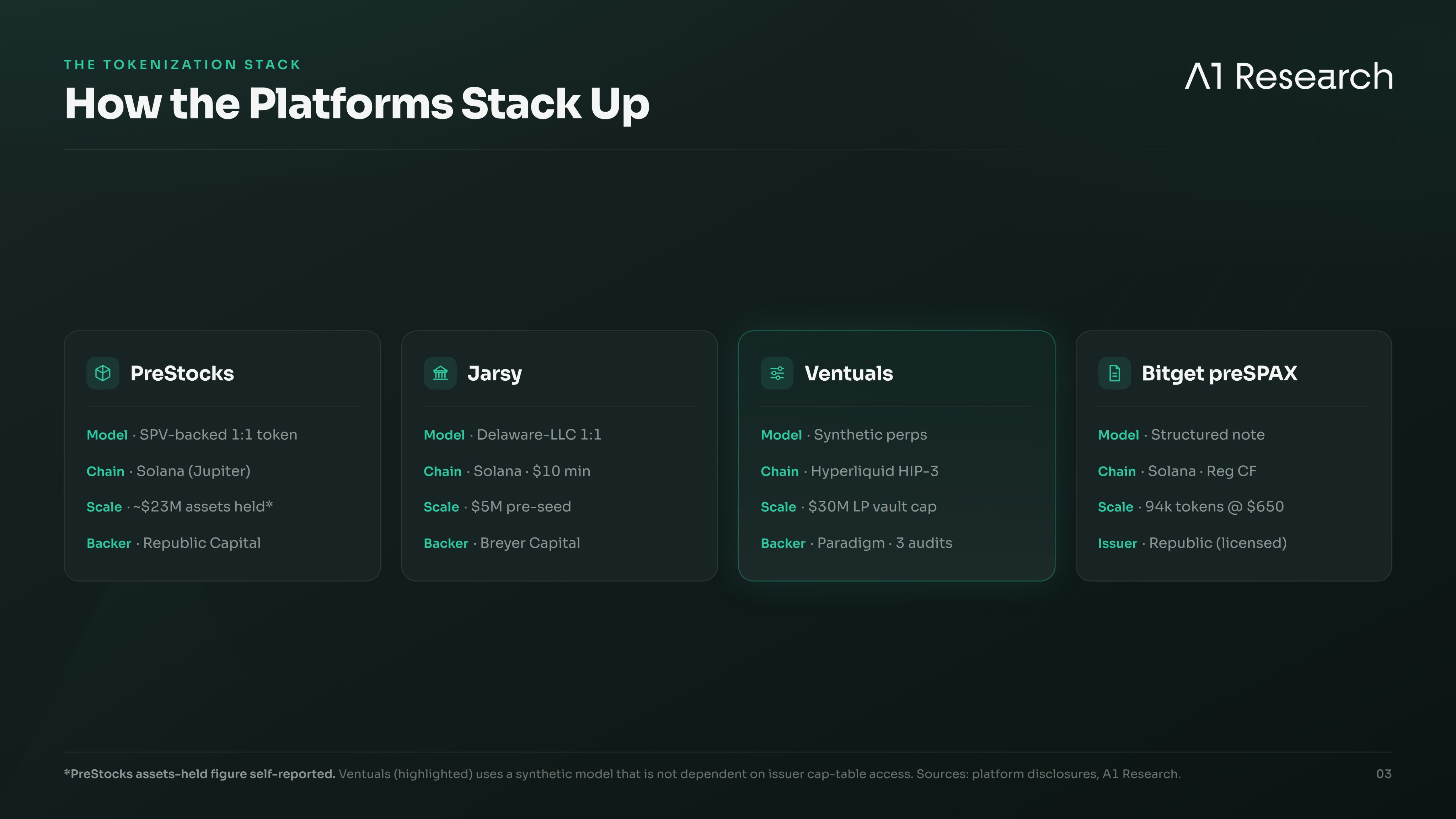
The market is not choosing one door. It is rotating away from Door 1, toward Doors 2 and 3, with Door 4 as the gravitational endpoint.
3. The Issuer Veto: Anatomy of "Void"
On May 12–13, 2026, Anthropic and OpenAI did something more aggressive than OpenAI's 2025 spat with Robinhood. Anthropic updated its investor-warning page to state that it does not permit SPVs to acquire its stock and that any transfer of shares to an SPV is "void" under its transfer restrictions adding that any third party selling exposure via "direct sales, forward contracts, tokenized securities, or other mechanisms" is "likely either engaged in fraud or offering an investment that may have no value." It has names: Forge Global, Hiive, Open Door Partners, Unicorns Exchange, Pachamama, Lionheart Ventures, Sydecar, and Upmarket. OpenAI issued a parallel warning that unauthorized transfers are invalid and "carry no economic value."
The single most important word is void, not voidable. As crypto counsel Gabriel Shapiro noted, the distinction is load-bearing under Delaware law: a voidable transfer can sometimes survive in the hands of a good faith buyer, while a void one is a legal nullity from inception. Blockchain immutability is irrelevant when the legal layer says the claim never existed.
But notice what the veto can and cannot reach. It governs share transfers. It lands squarely on Door 1, the SPV-backed custodial tokens, and not at all on Door 2, where no share moves and the issuer is not a counterparty to anything. Anthropic cannot void a USDC-settled bet between two strangers on Hyperliquid. The reaction proved it: PreStocks' Anthropic token fell roughly 35–50%, while Hyperliquid perps recovered after a ~23% dip and Polymarket-style synthetics were largely unaffected [19][20]. This is the mechanism by which the veto filters the category instead of killing it.
4. The Valuation Gap: What the On-Chain Market Is Actually Saying
The popular narrative that tokenized markets invent absurd, detached valuations does not survive contact with the corrected data.
Anthropic's valuation ladder is the proof. The company ran from ~$61.5B (March 2025) to $183B (Series F, September 2025) to $380B (Series G, February 12, 2026) to $965B (Series H, May 28, 2026) - a 2.5x re-rate in 105 days. Through that climb, on-chain venues (PreStocks, Ventuals) and private secondaries (Forge, Hiive) were already implying $1T+. When critics screenshotted a "$1.3T tokenized Anthropic" in early May, they framed it as mania. Two weeks later, a syndicate including Altimeter, Dragoneer, Greenoaks, and Sequoia priced the company at $965B. The on-chain market wasn't detached. It was early.
Re-anchored to the latest priced rounds, the gaps are unremarkable:
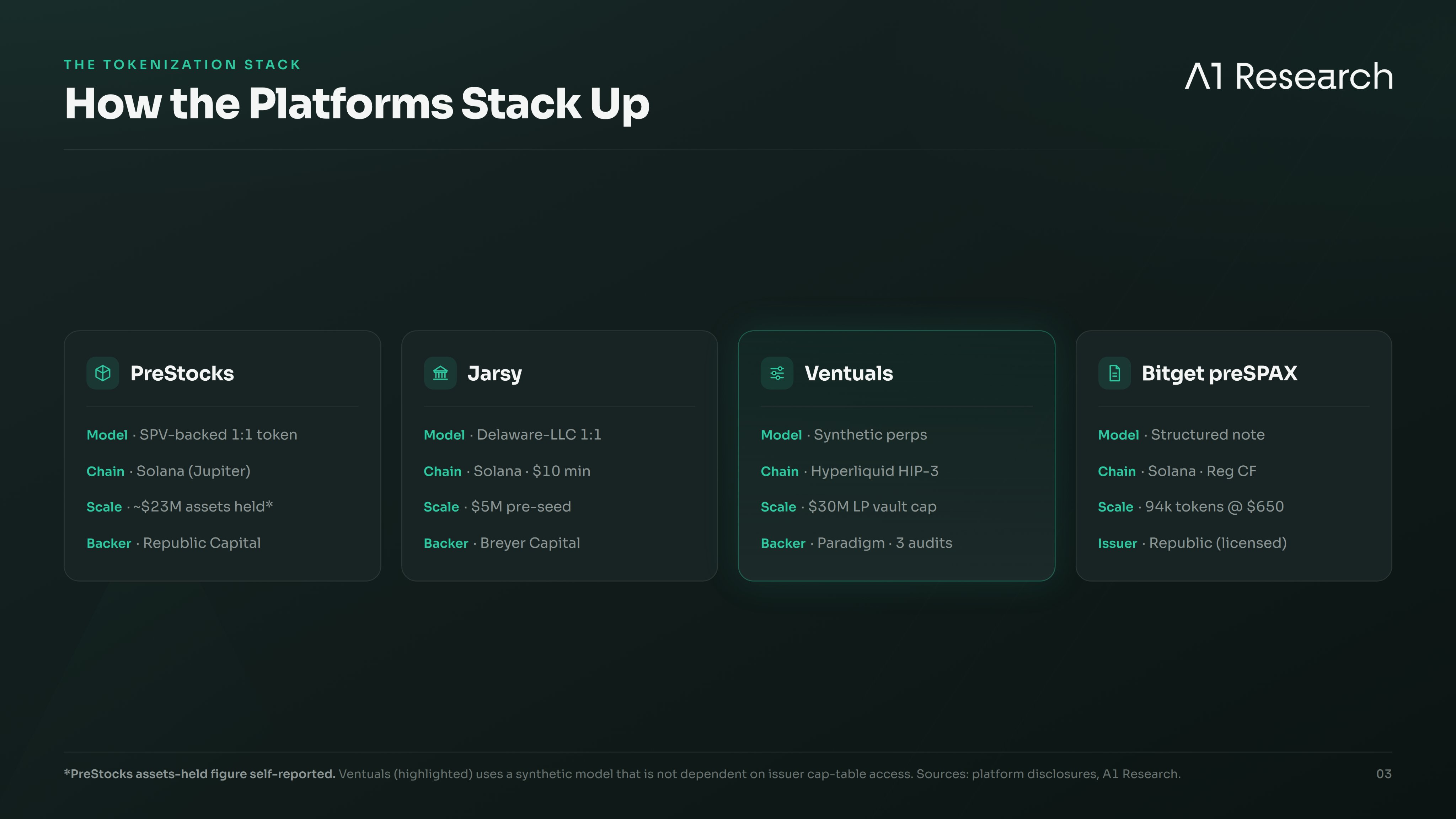
A +6% to +35% premium for the fastest-compounding private assets in history is a market doing its job, not losing its mind. SpaceX is the tell: its on-chain mark (~$1.5T) sits below the company's own $1.75-2T IPO target, because SpaceX is the most defined of the three, an S-1 on file removes the uncertainty premium. The closer the IPO and the better the disclosure, the tighter the spread. That is exactly how a functioning forward market should behave.
5. Liquidity and Backing: The Real Risk
The real test of a pre-IPO token isn’t only whether the price is right but also whether you can get your money back out.
On the custodial venues, often you can't. At the May peak, PreStocks showed an Anthropic valuation above $1.3 trillion while the entire platform held around $23 million in assets, with the Anthropic pool backed by roughly $333,000 in stablecoins and $18,000 in SOL. At that depth, the number on the screen is just what the last few trades printed, not a price anyone could sell into. The third-party attestations the platform promised at launch never appeared.
One thing genuinely separates this from its predecessors, and it cuts both ways: speed of disclosure. Because the holdings sit on-chain, the gap between the implied value and the actual backing was public within days. Linqto, a pre-crypto version of the same idea, hid a nearly identical failure for years before it collapsed and about 13,600 customers learned they never owned the shares they'd paid for. Visibility isn't a safety net, though. It means the warning signs are there to read. It doesn't stop anyone from ignoring them, and plenty of buyers did.
Synthetic venues drop the custody question and pick up a different one. There's no shell company to under-fund, but the price now leans entirely on an oracle, and an early pre-IPO perp running on a thin or stale feed can slide into guesswork. Ventuals blends an outside valuation mark with an on-chain moving average to keep its number tethered, which narrows the problem without solving it.
So the honest read is smaller than either side wants it to be. The valuations are defensible. The plumbing, on some venues, isn't. Before trusting a screen, find out what sits behind it: a funded, audited holding, or a figure two strangers settled on a minute ago.
6. Why They're Still Trading: The Bull Case
Despite the loudest possible "do not buy this" from the issuers themselves, the tokens are still live and still bid. Five reasons none of them naïve:
1. The dominant model is antifragile to the exact attack that was launched. Synthetic perps took no hit to their legal foundation on May 13 because there is no transfer to void. The market reorganizing around perps and structured notes in response to the veto isn't crypto failing, it's crypto routing around a constraint in real time, which is the whole point of permissionless infrastructure.
2. They are becoming genuine price discovery infrastructure. On-chain marks led Anthropic's $965B round, and founders have publicly said they check venues like Ventuals to value their own shares. For an asset class whose native price input is a deliberately-deflated, 90-day-old 409A, a continuous 24/7 reference rate is a real improvement, not a casino.
3. The demand is structural. A >$10T private market with no retail on-ramp is the single largest asset class walled off from the people most exposed to its products. Protocols like Jarsy opens the door at $10 against the six-figure minimums of legacy secondaries. That demand does not evaporate because an issuer posts a warning; it re-routes to whichever structure survives.
4. The veto creates expected value, it doesn't zero it. Post-void, prices fell ~40% but did not go to zero. The market is pricing the probability that the IPO converts exposure into resolved value or that the structure is grandfathered. Anthropic's June 1 IPO filing is itself the redemption catalyst: the event that turns a contested claim into a public price.
5. The rails are professionalizing fast. The SEC's January 2026 statement explicitly encouraged issuer-approved tokenization; Nasdaq and NYSE secured tokenized-trading approvals; an "innovation exemption" is paving the road for public company tokens. Today's grey-zone SPV tokens are the messy beta of a category that is being pulled into the regulatory perimeter, not pushed out of it.
7. The Endgame: Issuer-Native Issuance
Every other door is a workaround for the same missing primitive: an issuer willing to make the token be the share. For public companies, that primitive now exists. Through Superstate's Opening Bell, Galaxy Digital became the first public company to issue tokenized stock on Solana, with SharpLink following on Ethereum tokens that carry the same CUSIP as their listed shares and grant holders the same rights. The SEC's position is that using a distributed ledger as the recordkeeping mechanism does not change the legal analysis: a tokenized share with an on-chain registry has the same status, and the same obligations, as a traditional one. New plumbing, same rules.
That reframes the entire pre-IPO debate. The binding constraint was never custody, transparency, or even regulation, it was issuer consent. And issuer consent is a choice. The AI labs that are voiding SPV transfers today could, post-IPO (or even via an authorized pre-IPO program), capture that retail demand natively and on their own terms with the lock-ups, transfer rules, and proof-of-reserves enforced in code rather than litigated after the fact.
So the real question for OpenAI, Anthropic, and SpaceX is not whether their equity ends up on-chain. The synthetic market has already proven there is durable, global, 24/7 demand to price it. The question is whether they keep fighting that demand from the outside or issue it from the inside. The first major private company to do the latter will not be democratizing access as a favor. It will be capturing a liquidity pool its rivals are currently handing to anonymous perp venues for free.
Risks and Open Questions
- Legal escalation. Issuers have so far warned rather than sued. Coordinated enforcement against custodial venues, or SEC action treating synthetic perps as unregistered security-based swaps offered to retail, would compress the category fast.
- Oracle integrity. Synthetic venues are only as good as their valuation feeds. A manipulated or stale oracle during an IPO-pricing event is the most likely vector for a disorderly unwind.
- The conversion event is untested. No one has yet watched a major pre-IPO token resolve through an actual IPO. SpaceX, listing this month, is the first real stress test of what happens to these instruments at the moment of truth.
- Liquidity is thin where it matters. Until proof-of-reserves and redeemability are standard on custodial venues, screen valuations should be read as sentiment, not exit prices.
Conclusion
The pre-IPO tokenization story is being written as a morality tale, reckless crypto sells fake equity, real companies shut it down. The data tells a more interesting story. The on-chain market priced the most important AI round of the year before the professionals did; the issuer veto pruned the weakest structure and accelerated the strongest; and the regulatory and technical path toward legitimate, issuer-native tokenized equity is already paved for public companies and inching toward private ones. The mega-IPOs of June and beyond will not end this experiment. They will be its first settlement event and the moment the market finds out how right it already was.
Disclaimer: This content is for informational and educational purposes only and does not constitute investment, financial, or legal advice, or an offer to buy or sell any security or digital asset. Figures are point-in-time estimates reconciled from public sources and may be inaccurate or outdated. Tokenized pre-IPO instruments carry significant legal, liquidity, and counterparty risk, including total loss. Do your own research.
Поделиться исследованием
A1 Team · Макро и рынки
Ещё от A1 Research
Все статьиЧитать: Greenland Tariffs and the Failure of the Digital Gold Thesis  Макро и рынки
Greenland Tariffs and the Failure of the Digital Gold Thesis
On January 17, 2026, the Trump administration announced 10% tariffs on eight European nations, effective February 1, escalating to 25% by June 1 unless Denmark agrees to sell Greenland.

 A1 Team, Derek20 мин чтения
Читать: Why the Venezuela Intervention Didn't Move Crypto  Макро и рынки
Why the Venezuela Intervention Didn't Move Crypto
On January 3, 2026, the United States launched Operation Absolute Resolve, a military intervention in Venezuela that captured President Nicolás Maduro and his wife Cilia Flores. It was the most significant US…
A1 Team, Derek7 мин чтенияЧитать: What to Expect in 2026  Макро и рынки
What to Expect in 2026
If there was ever a year that represents the volatility of crypto, it was 2025.
A1 Team41 мин чтения