Zero: The Multi-Core Revolution or Maximum Hype?
Zero introduces a heterogeneous "multi-core" architecture that separates execution (datacenter Block Producers) from verification (consumer-grade Nano Validators via ZK proofs), claiming 2 million…

Key Takeaways
- Zero introduces a heterogeneous "multi-core" architecture that separates execution (datacenter Block Producers) from verification (consumer-grade Nano Validators via ZK proofs), claiming 2 million TPS per zone at $0.000001 per transaction. No blockchain has achieved anything close to these figures in production.
- LayerZero's distribution moat is the real differentiator: 168 connected chains, 700+ applications (PayPal, Ondo, Paxos, BitGo, Ethena), $225 billion in cumulative volume, and dominant market share in cross-chain messaging. No greenfield L1 has ever launched with comparable ecosystem connectivity.
- Institutional backing is also strong for a crypto-native project: Citadel Securities (direct token purchase), ARK Invest (Cathie Wood on Advisory Board), DTCC, ICE (NYSE parent), and Tether. However, most are "exploring" or "evaluating," not (committing to) deploying (yet).
- Component benchmarks are academically substantiated (QMDB and FAFO papers published on arXiv with open-source code), but integrated system performance is entirely unverified. History is unkind to theoretical TPS claims: Solana currently achieves 2-6% of its ceiling in production.
- Canton Network is the most underappreciated competitive threat. It is already live with Goldman Sachs, HSBC, BNP Paribas, and 400+ institutions, processing $365 billion in daily repo volume through Broadridge, and backed by an SEC no-action letter for tokenized U.S. Treasuries.
- Token dilution is the most quantifiable near-term risk: ~437 million ZRO unlock over 17 months (more than doubling circulating supply), with monthly buybacks offsetting less than 1.5% of sell pressure. The fee switch, which could transform token economics, has failed quorum three consecutive times.
- Zero is a high-conviction asymmetric bet. The September 2026 mainnet launch is the first real test of whether LayerZero's middleware dominance can translate into L1 relevance.
The Technical Unlock
To understand why Zero matters, start with the bottleneck it claims to solve. Every major blockchain today runs on what amounts to a single-core architecture. On Ethereum, all validators independently re-execute every transaction to verify correctness. The result is airtight security at a brutal cost: the network processes roughly 20 to 30 transactions per second. L1 fees have improved dramatically post-Dencun (averaging around $0.20 per transaction in early 2026), but that still represents a structural overhead of paying thousands of validators to repeat identical work, and fees spike well above $1 during any sustained congestion. Solana introduced multi-threaded parallel execution to push throughput higher, but it remains homogeneous at heart. Every @solana validator still performs the same work, which is why real-world throughput sits at roughly 1,300 to 4,000 TPS (far below the frequently cited 65,000 theoretical ceiling), and running a validator demands datacenter-grade hardware that most participants cannot afford.
Zero takes a fundamentally different approach: heterogeneous architecture. The network splits validators into two functional classes with entirely separate hardware requirements and responsibilities. Block Producers handle the heavy computation, executing transactions, managing state, and generating zero-knowledge validity proofs, on datacenter hardware with GPU clusters. Block Validators (referred to as "Nano Validators") perform only one task: verifying those compact ZK proofs, a process that takes milliseconds on consumer-grade machines. Validators retain final authority over which blocks are accepted through a Pure Delegated Proof of Stake (PDPoS) consensus mechanism, which preserves censorship resistance despite the asymmetry between the two classes.

LayerZero
@LayerZero_Core
Zero: The Decentralized Multi-Core World Computer
Zero introduces the first multi-core world computer, a fundamental departure from the single-threaded, homogeneous architectures that constrain current blockchains. By leveraging Zero-Knowledge (ZK)
2026-02-10View on X
The "multi-core" label comes from Atomicity Zones, independent execution environments running in parallel, analogous to cores in a modern CPU. Three zones are planned at launch: a general-purpose EVM-compatible zone for Solidity smart contracts, a privacy-focused payments zone using ZK proofs for transaction confidentiality, and a purpose-built trading venue targeting tokenized securities and high-frequency markets. These zones are not sovereign chains, L2s, or rollups. They share a unified protocol, governance, and validator set. Each zone can theoretically reach 2 million TPS independently, with aggregate throughput scaling as a multiple of that figure.
Why This Cuts Costs Without the Usual Trade-Off
The blockchain trilemma has always forced builders to choose. Want speed and low cost? Sacrifice decentralization (Solana's datacenter hardware requirements). Want decentralization? Accept slow throughput and high fees (Ethereum's universal re-execution). Zero's architecture attempts to sidestep this by decoupling execution from verification at the protocol level.
The cost reduction is structural. In a traditional blockchain, you pay for thousands of redundant executions. In Zero's model, you pay for one execution and thousands of cheap verifications. @LayerZero_Core claims this drives transaction costs to $0.000001, roughly three to four orders of magnitude below Ethereum L1 averages and three orders below Solana. If those numbers survive contact with production traffic, the implications for on-chain financial infrastructure are significant.
The caveat is equally important: no blockchain in history has achieved anything close to 2 million TPS in real-world operation. Carter Feldman (Psy Protocol founder) noted in Cointelegraph that "many pre-mainnet, testnet or isolated benchmarking tests measure TPS with only one node running." Even Solana, which had years to optimize, achieves roughly 2 to 6% of its theoretical throughput in production. Fortune acknowledged the same tension: "At this point, everything is still theoretical."
Comparative Snapshot: Zero vs. The Giants
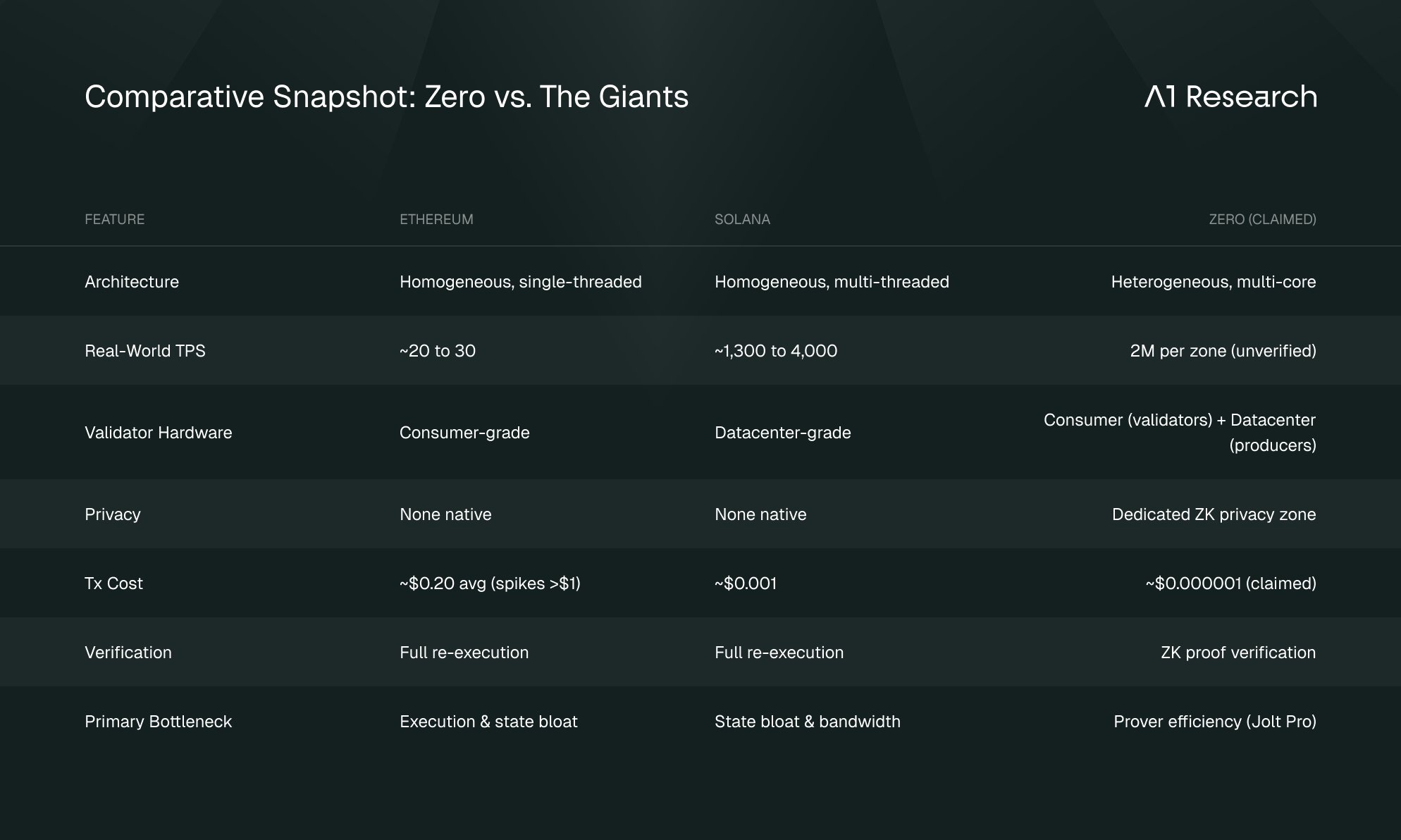
A note on the Solana column: the 65,000 TPS figure frequently cited by media and marketing materials has never been achieved in production. Excluding vote transactions, Solana's actual throughput ranges between 1,300 and 4,000 TPS. This matters because Zero's claimed 500x advantage over Solana depends entirely on which Solana number you use as the denominator.
The Four Pillars: Component Benchmarks vs. System Reality
Zero rests on four independently developed systems:
- QMDB (Quick Merkle Database) is the most academically substantiated component. Published on arXiv with an open-source repository (dual-licensed under MIT and Apache 2.0), QMDB replaces the Merkle Patricia Tries used by most blockchains with an append-only, log-based key-value store optimized for modern SSDs. Benchmarks show up to 3 million state updates per second (the official announcement cites 2.28 million under specific configurations) and 1 million TPS for transfer workloads, using only 2.3 bytes of DRAM per entry. Independent testing puts it at 8x faster than NOMT, the previous state-of-the-art verifiable database. It has been stress-tested with workloads up to 15 billion entries, roughly 10x Ethereum's current state size.
- FAFO (Fast Ahead-of-Formation Optimization) handles parallel execution. Also published on arXiv and open-sourced, FAFO achieves 1.12 million EVM transactions per second (native ETH transfers) and over 500,000 ERC20 transfers per second on a single 96-core machine. Its key differentiator from Solana's approach is automatic conflict detection: developers do not need to manually declare read/write sets. Unlike Aptos's Block-STM, FAFO avoids speculative execution and rollbacks entirely. All transactions are guaranteed conflict-serializable before execution through a four-stage pipeline (ParaLyze, ParaFramer/ParaBloom, ParaScheduler, Execution). The "2,500x faster than BNB Chain" and "91% lower infrastructure cost than sharded execution" claims come from LayerZero's own comparisons and have not been independently replicated.
- Jolt Pro is an enhanced version of a16z crypto's open-source Jolt zkVM, ported to CUDA for GPU acceleration. A single proving "cell," consisting of 64 NVIDIA GeForce RTX 5090 GPUs, achieves 1.61 GHz proving speed (1.61 billion RISC-V cycles per second), claimed to be roughly 100x faster than existing zkVMs. The roadmap targets 4 GHz by 2027, which would equal a single modern CPU core. Yet, the 64-GPU requirement for a single proving cell (hardware running into hundreds of thousands of dollars) raises legitimate centralization concerns about Block Producer concentration.
- SVID (Scalable Verifiable Information Dispersal) is the least documented component. Based on erasure-coding principles similar to Semi-AVID-PR, it allows validators to download less than 0.5% of block data (for 128 MiB blocks). Claimed throughput exceeds 1 GB/s on nano validators with a roadmap to 10 GiB/s, described as 1,000x faster than Ethereum's PeerDAS.
The integration gap remains the central question:
Individual benchmarks are strong: QMDB handles up to 3M state updates per second, FAFO executes 1.12M EVM TPS, and SVID pushes over 1 GB/s. But 2 million TPS as a fully integrated, running blockchain has never been demonstrated. History offers a sobering pattern: Solana went from 65,000 theoretical to 1,300 to 4,000 actual; EOS went from 4,000 claimed to roughly 50 actual. Even 10% of Zero's claimed figure (200,000 TPS) would be extraordinary by current standards.
The Moat: Why Zero Is Not "Just Another L1"
Skepticism is natural when a new L1 launches, but LayerZero's starting position is genuinely unique. This is not a startup building its first product. LayerZero is the dominant cross-chain messaging protocol, and the numbers back that claim:
- 168 active chains connected (up from roughly 70 in mid-2024)
- $225 billion in cumulative transfer volume ($70 billion of that from Tether's USDt0 alone)
- 159 million+ messages delivered
- Market share dominator in cross-chain transaction volumes (consolidated after the Stargate acquisition in August 2025)
- Roughly 2/3 of all issued stablecoins supported by LayerZero infrastructure as per Messari.
- 700+ applications including PayPal, Ondo Finance, Paxos, BitGo, and Ethena

YEdu
@yashascore
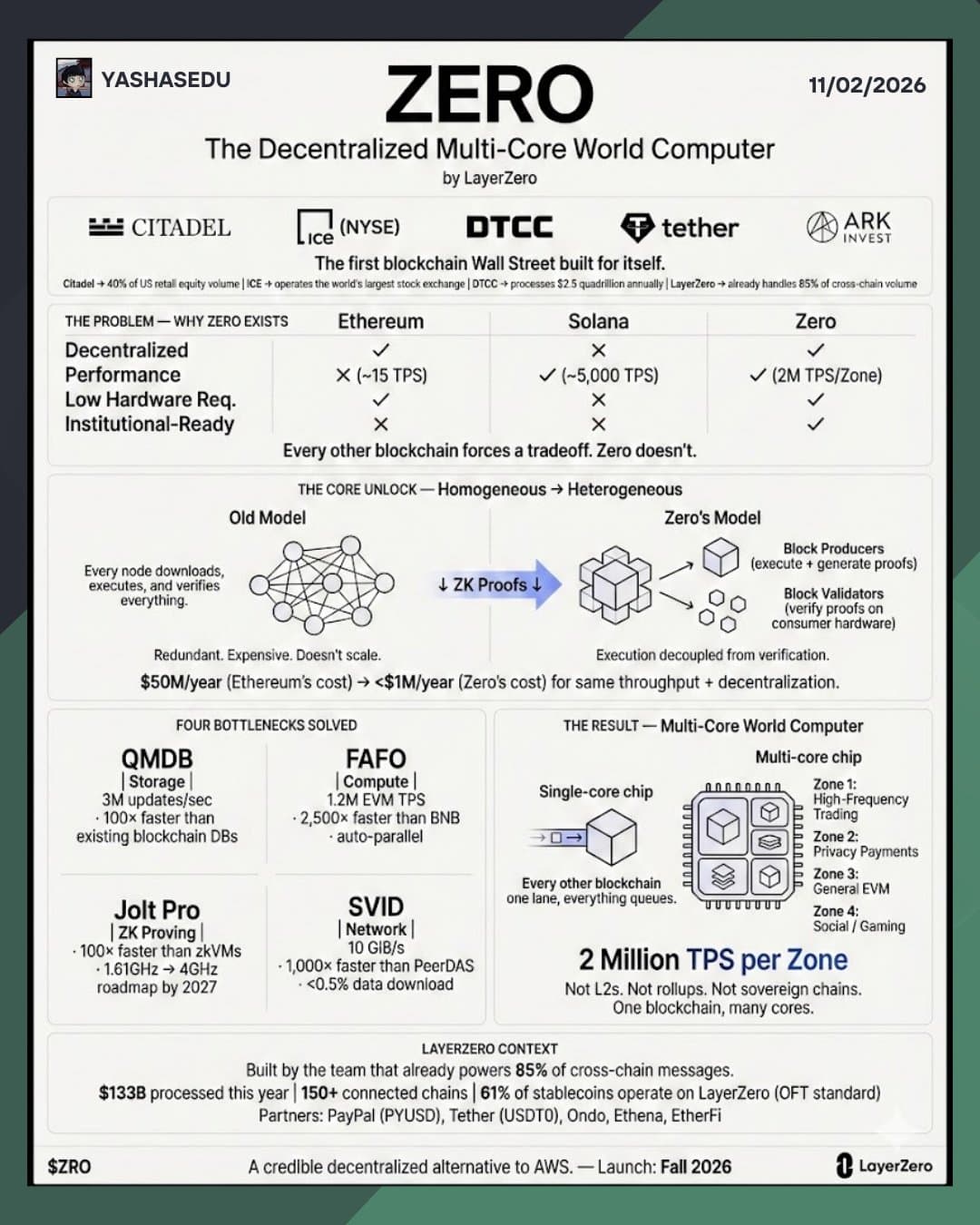
Everyone who is going to call @LayerZero_Core' Zero, just another L1. It's not. Here's why👇 ➢ Already controls ~75% of crosschain messaging ➢ 150+ chains connected ➢ $100B+ processed Zero uses a heterogeneous architecture so there's no redundant work + same decentralization as Ethereum at less than 2% of the cost. Has 2M TPS/zone which means multiple zones running in parallel like cores on a CPU. Citadel, DTCC, ICE and Tether are the firms that literally run Wall Street's settlement infrastructure, which are backing it. They already own cross-chain messaging. Now they want the settlement layer too. This changes the game for $ZRO entirely.
2026-02-11View on X
Every new L1 faces the cold-start problem: no users without apps, no apps without users. Zero launches with day-one connectivity to 168 chains and an ecosystem of 700+ applications already fluent in LayerZero's messaging standard. No greenfield L1 competitor has ever had comparable distribution at launch.
The strategic logic behind launching an L1 is straightforward. Cross-chain bridging has a visible revenue ceiling; it is a utility where users pick the cheapest option. By building an L1, LayerZero shifts from earning fees on transit to capturing value from assets that live and settle on its chain. This mirrors a broader verticalization trend across crypto infrastructure: Tether made a strategic investment in LayerZero (announced February 10, 2026), Circle is building its own chain, Stripe launched its Tempo payments blockchain on public testnet, and Google Cloud launched its own Universal Ledger. LayerZero's advantage is that it already controls the connective tissue between chains.
The "conflict of interest", however, deserves scrutiny.
LayerZero's core business in cross-chain interoperability explicitly benefits from blockchain diversity. The more chains exist and the more fragmented the landscape, the more valuable its infrastructure becomes. Zero changes that positioning. By launching an L1, LayerZero now competes with the platforms it connects. Think Amazon entering retail categories that its marketplace sellers already occupy. If Zero succeeds in absorbing liquidity from other chains, does the messaging business cannibalize itself? LayerZero would argue the opposite: that Zero becomes a gravitational center that makes the rest of the ecosystem more dependent on its infrastructure. The answer will depend on execution.
Wall Street and the Institutional Narrative
The institutional roster backing Zero is very strong for a crypto-native project. But the language surrounding each partnership matters as well, and the gap between "exploring" and "deploying" has consumed many blockchain narratives in the past.
Citadel Securities, which processes roughly one-third of all U.S. retail equity orders, made a direct strategic investment in ZRO tokens (amount undisclosed) and is providing "market structure expertise" while evaluating Zero for "trading, clearing, and settlement workflows." CoinDesk noted that direct token purchases are highly unusual for a firm like Citadel Securities. The signal is genuine, but the operative word is "evaluate," not "deploy."
ARK Invest became both an equity shareholder and ZRO token holder. Cathie Wood personally joined LayerZero's Advisory Board. Investment size remains undisclosed.
DTCC is a "Day Zero Partner" investigating Zero to enhance its DTC Tokenization Service and Collateral App Chain. The language, however, is explicitly exploratory: "investigate," "explore," "working collaboratively." And here is the detail that should temper enthusiasm: DTCC simultaneously co-chairs the Canton Network Foundation and is already at the MVP stage for tokenized U.S. Treasuries on Canton, backed by an SEC no-action letter. That is a far more advanced engagement than anything announced with Zero.
ICE (NYSE's parent company) is examining Zero for 24/7 trading and tokenized collateral infrastructure. Michael Blaugrund, VP of Strategic Initiatives at ICE, joined Zero's Advisory Board.
Tether Investments made a separate strategic investment on the same day as the announcement (amount undisclosed).
The advisory board, which includes Cathie Wood, Michael Blaugrund, and Caroline Butler (former Head of Digital Assets at BNY Mellon), provides real TradFi credibility. But the core reality is that every institutional partner is exploring, evaluating, or investigating. Institutions routinely hedge by engaging multiple platforms simultaneously. DTCC's dual relationship with both Canton and Zero is the clearest illustration of this dynamic.
Canton Network: The Competitor That Is Already Live
The competitive landscape for Zero is broad (Ethereum L2s, Solana, Sui, Aptos, Hyperliquid, Monad, MegaETH), but one competitor stands apart when it comes to institutional ambitions, and it is not any of the usual suspects.
@CantonNetwork is already in production, with a roster that includes Goldman Sachs, BNP Paribas, HSBC, Bank of America (which completed its first 24/7 on-chain Treasury financing in August 2025), Deutsche Börse, and Euroclear. Over 400 financial institutions are live on the network. To put Canton's scale in concrete terms: Broadridge's Distributed Ledger Repo platform, which runs exclusively on Canton, averaged $365 billion in daily par value in January 2026, a 508% increase year-over-year. DTCC selected Canton in December 2025 to tokenize DTC-custodied U.S. Treasury securities, and that effort is backed by an SEC no-action letter.
Canton uses a "public permissioned" architecture with Daml smart contracts that provide transaction-level privacy meeting Basel regulatory standards natively. This is precisely the kind of walled-garden design that banks favor: inherent privacy, regulatory alignment, and a controlled participant set. Canton's CEO Yuval Rooz has directly critiqued ZK-based privacy approaches like Zero's, pointing to ongoing vulnerabilities in ZK systems. A topic they also covered in on their blog.
Zero's counter-argument rests on three advantages: its permissionless design (anyone can validate, not just approved institutions), its 168-chain interoperability through LayerZero's existing infrastructure, and a crypto-native community that could drive broader adoption beyond institutional silos. LayerZero is also deploying an Endpoint on Canton itself, which hints at potential complementarity rather than pure head-to-head competition.
The question for investors is whether the institutional market actually wants a permissionless chain, or whether regulatory requirements will keep banks within controlled environments like Canton for the foreseeable future. Zero is making a bet that "Privacy Zones" on a permissionless ledger can offer global liquidity while satisfying compliance. That is a bold technical vision with a probably much steeper regulatory climb than Canton's approach.
The Broader Competitive Response
Zero does not enter a static market.
Ethereum and L2s (Base, Arbitrum, MegaETH) are already driving effective transaction fees toward zero and scaling to millions of daily transactions. Yet, Zero attacks the centralization weakness common to L2s: most sequencers are single operators with upgrade authority. But Ethereum's roughly $54 billion in DeFi TVL (on L1 alone, while Arbitrum has $3.5B and Base $2.5B in value secured), mature security track record, and enormous developer base create powerful lock-in. Robinhood launched its own chain (public testnet) on Arbitrum the same week, a reminder that at least some players in the L2 ecosystem continues to attract serious capital regardless of L1 challengers.
Ethereum's own L1 roadmap also points toward ZK-based verification, which narrows Zero's architectural differentiation over time. Vitalik Buterin's May 2025 proposal to replace the EVM with RISC-V targets 100x execution efficiency gains through ZK-friendly instruction sets. The Glamsterdam upgrade (mid-2026) pushes the gas limit from 60M to 200M, and zkEVM-based block validation is expected to begin partial validator adoption in 2026, with a path toward becoming the primary validation method by 2027 to 2030. Justin Drake's Beam Chain proposal redesigns the consensus layer around ZK proofs entirely, though that is a 2028+ deliverable at the earliest. None of this matches Zero's claimed throughput, but it does mean Ethereum is converging on the same architectural thesis (separate execution from verification via ZK proofs) through incremental upgrades rather than a clean-sheet design. Zero's window of structural advantage is real, but it is measured in years, not decades.
A notable signal cutting the other direction: @GTE_XYZ, the Paradigm-backed decentralized trading platform ($15M raise, June 2025), left @megaeth to build its Turbo Treasury Layer on Zero (see posts linked below). This suggests that for teams building institutional-grade trading infrastructure, Zero's value proposition is already resonating over some of the most anticipated L2 alternatives.
Post on X
This post is no longer available on X.
View on X

enzo
@enzo_gte
Let me make this very simple for you: - Other L1 blockchains are fast -- Zero is the fastest. - Other L1 blockchains require apps to share blockspace leading to congestion -- Zero lets apps like GTE be next to institutions like ICE, DTCC, etc while being natively interconnected. - $ZRO is already generating revenue, has made major partnerships, and is positioned for long term value capture as more institutions show up Lay the foundations, capture the value, and continue to expand. $ZRO = the last L1 blockchain we need.
2026-02-12View on X
Solana remains the dominant monolithic performer and the undisputed leader in consumer-facing speed. Five years of battle-tested mainnet operation, a massive developer community, and Jump Crypto's Firedancer client approaching 1 million TPS in synthetic testing all reinforce its position. Production throughput is modest in absolute terms (~1,300 to 4,000 TPS excluding vote transactions), but Solana has survived multiple stress tests, outages, and recoveries. That operational history carries weight that benchmarks on paper cannot replicate.
A broader macro trend also deserves attention. The Block's 2026 L1 Outlook noted that despite L1s capturing 90% of total crypto market capitalization, they now collect only 12% of protocol fees, down from 60% in 2025. Throughput is becoming commoditized. Value is migrating to the application layer. This raises the question of whether raw TPS, even if Zero delivers on its claims, will be the differentiating factor that drives adoption, or whether the market has already moved past infrastructure as the primary value driver.
Tokenomics: The Upside and the Cliff
The repricing thesis:
The launch of Zero introduces a structural shift in how the market should value ZRO. Before the announcement, ZRO functioned as the governance token for a cross-chain messaging protocol, often even just referred to as a "bridge". After the announcement, it becomes the native gas token for a high-performance L1 with institutional backing, comparable in function (if not yet in scale) to SOL or SUI. The market responded accordingly: ZRO surged over 40% on the Zero announcement, jumping from roughly $1.65 to a $2.59 intraday high, while the broader market declined. It currently trades at approximately $2.0, with a fully diluted valuation of $2 billion against a fixed total supply of 1 billion tokens.
The dilution cliff is the most quantifiable near-term risk:
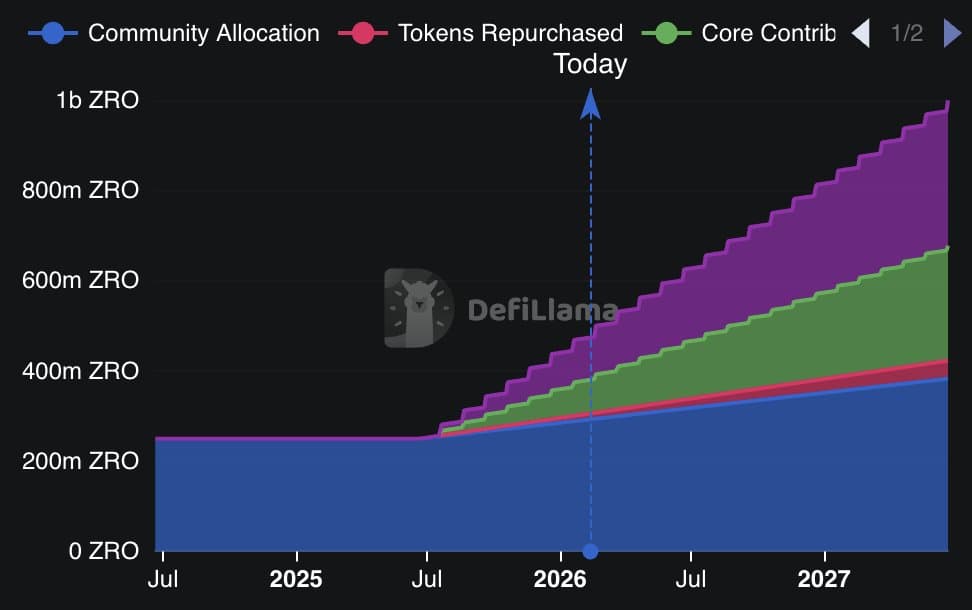
Token allocation breaks down as follows: 38.3% to community (mixed vesting), 32.2% to strategic partners (3-year vesting with a 1-year cliff followed by 24-month linear unlock), 25.5% to core contributors (same schedule), and 4% repurchased tokens pledged to community. The one-year cliff expired in June 2025, triggering monthly linear unlocks of approximately 24 to 31 million ZRO that continue through June 2027.

CBB
@Cbb0fe
I’ve seen a lot of shilling around $ZRO, and what they’re trying to achieve seems quite cool But no one is mentioning the 100% token inflation within one year It's a pass for me for that reason
2026-02-11View on X
Unfortunately, the math is unforgiving. With roughly 200 million tokens in free-float circulation (per CoinGecko; CoinMarketCap reports ~299M including unlocked ecosystem allocations), approximately 437 million additional tokens will unlock over the remaining 17 months. That represents more than a doubling of circulating supply. At current prices, roughly $50 million in new supply hits the market each month.
The buyback program provides only marginal offset.:
Monthly buybacks, funded by 50% of Stargate revenue (shifting to 100% after February 2026), have purchased a total of 1,348,609 ZRO (~$2.0 million) through January 2026:
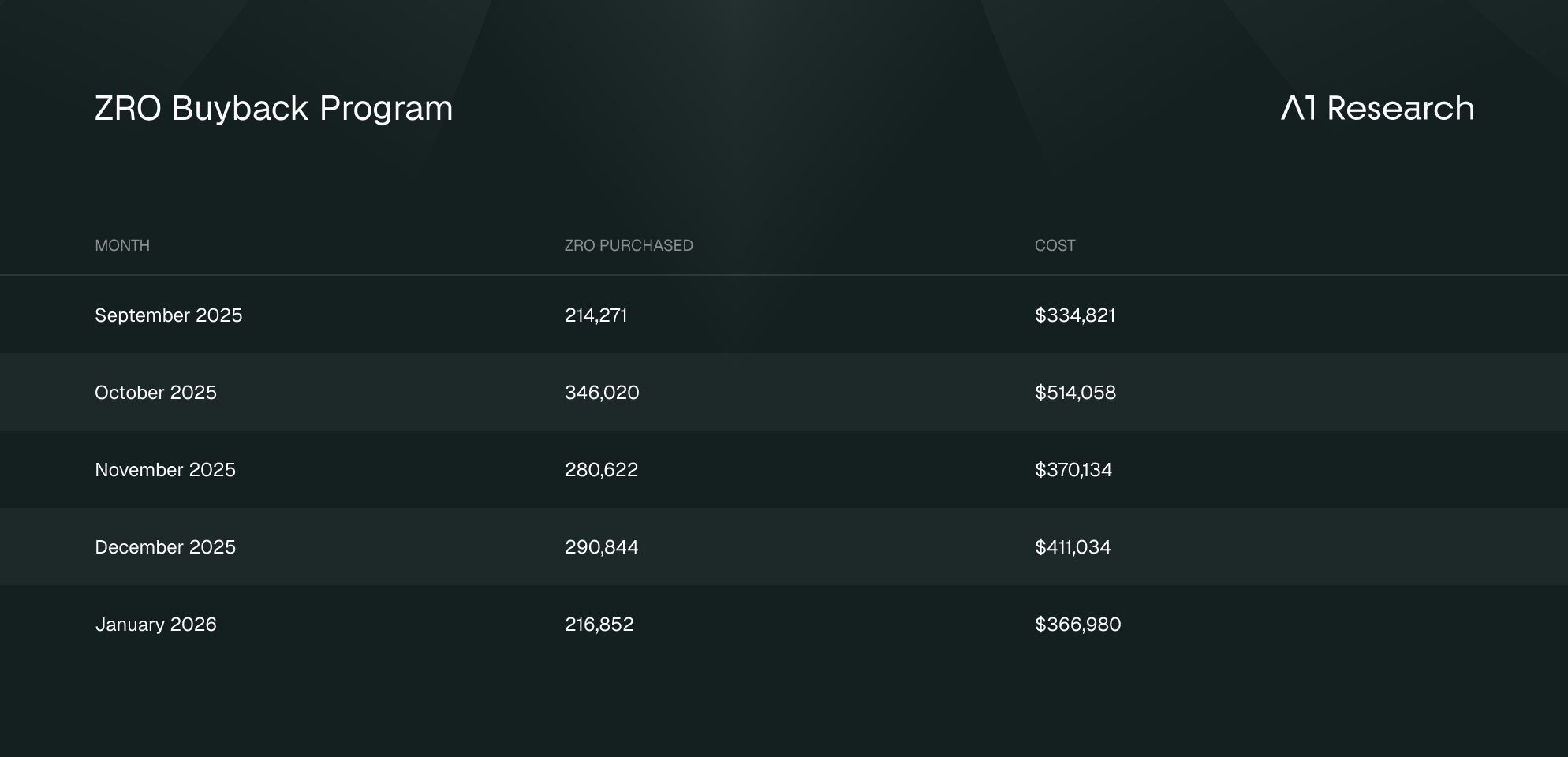
Total buybacks offset less than 1.5% of monthly unlock pressure. LayerZero has stated a $100 million annual revenue run-rate target for Stargate in 2026, and the shift to 100% of revenue going to buybacks will increase absorption. But even at that level, buybacks would cover only a fraction of new supply.
The fee switch is the wild card, and it remains inactive.
An immutable smart contract would allow ZRO holders to activate a protocol-level fee on every cross-chain message, with 100% of collected fees converted to ZRO and burned. This mechanism could be transformative for token value if activated. The problem: it has failed to reach quorum in three consecutive governance referendums (December 2024, June 2025, December 2025). The next vote is scheduled for approximately June 2026, with a further reduced quorum threshold. Until the fee switch activates, ZRO lacks a direct mechanism to convert network activity into token value capture.
Conclusion
Zero is not just hype and vaporware. QMDB and FAFO have academic papers and open-source code. Jolt Pro builds on a16z's well-documented Jolt zkVM. The individual component benchmarks (up to 3 million state updates per second, 1.12 million EVM TPS, 1.61 GHz proving speed) are specific, testable claims backed by published methodologies. This puts Zero's technical foundation several credibility levels above many more generic L1 launches.
What makes Zero structurally interesting though is not the TPS headline but rather the distribution advantage. No L1 has ever launched with connectivity to 168 chains, 700+ ecosystem applications, huge market share in cross-chain messaging, and relationships with both the largest stablecoin issuer (Tether), the largest market maker (Citadel Securities) and various institutional backers. The interoperability moat is real and difficult to replicate on any reasonable timeline. Early builder migration, like GTE choosing Zero over MegaETH for its institutional trading stack, suggests the value proposition is landing with at least some high-signal teams.
The bear case is equally concrete though. Canton Network holds a multi-year head start with exactly the institutions Zero is targeting, and it is already processing millions of daily transactions across billions in tokenized assets. Meanwhile, the ZRO token economics create persistent dilution through mid-2027, with roughly $50 million in monthly sell pressure against sub-$500,000 in monthly buybacks, and very TPS claim is pre-production. Also: building a thriving L1 ecosystem from scratch remains one of the hardest challenges in crypto, even for well-capitalized, highly anticipated projects. Sui, Aptos, Eclipse, Movement or Berachain and countless predecessors have demonstrated that strong technology and/or serious funding and hype do not automatically translate into developer adoption or sustainable on-chain economies. LayerZero's existing distribution gives it a structural edge that those projects lacked, but translating messaging-protocol users into native L1 activity is an unproven conversion.
For investors, the honest framing is this: Zero represents a high-conviction, asymmetric bet. It requires belief that LayerZero's middleware dominance can translate into L1 relevance, that institutional "exploration" will convert to deployment commitments, and that the technology will perform at even a meaningful fraction of claimed levels in production. The September 2026 mainnet launch will be the first real test. Until then, the same institutional-grade conviction that drives interest in Zero should also demand institutional-grade skepticism toward every unverified claim.
Compartilhe este research
A1 Team · Geral
Mais da A1 Research
Ver Todos os ArtigosLer: The Card Always Wins  Geral
GeralThe Card Always Wins
The $15 billion market that's quietly becoming crypto's most compelling consumer product.
 A1 Team21 min de leitura
Ler: Why Everything Is Becoming a Perp  Geral
GeralWhy Everything Is Becoming a Perp
Perpification is what happens when financial nihilism meets infrastructure that lets you lever anything, in a world that won't sit still.
 A1 Team, Sakshi17 min de leitura
Ler: Analyst Take: The Internet Is Learning How to Pay Itself and Crypto Is the Reason  Geral
GeralAnalyst Take: The Internet Is Learning How to Pay Itself and Crypto Is the Reason
Coinbase is building the AWS of agent commerce. AWAL + x402 + Stripe integration creates a full-stack moat on Base. Solana competes on speed, but integration depth will matter more than settlement time.
Sakshi, A1 Team6 min de leitura